
Observing Bali over three decades reveals distinct patterns across economic expansion, recovery phases, and regulatory updates. In 2025, Bali welcomed a record-breaking seven million foreign visitors by air.
By 2026, foreign arrivals stabilized into a deliberate plateau rather than continuing an endless upward climb. First-quarter 2026 arrivals recorded a modest one percent increase, reaching approximately 4.6 million foreign visitors between January and August—matching the previous year’s pace.
The provincial tourism authority established a 2026 target of 6.625 million visitors. Setting a target below historical results represents a deliberate policy signal favoring managed yield over unmonitored volume.
Meanwhile, star-rated hotel occupancies averaged between the high fifties and low sixties through the first half of the year. While visitor totals remained high, room utilization stabilized, demonstrating that accommodation demand shifted heavily into unrecorded alternative rentals.
How does business legal enforcement in Bali affect foreign investment and the broader economy? The answer centers on data visibility, digital registration, and strict statutory enforcement across all commercial property sectors.
Shifting from Shadow Tourism to Registered Visibility
Regional authorities are systematically moving unrecorded commercial activity into formal government registers.
Key actions executed in 2026 demonstrate how business legal enforcement in Bali reshapes local operations:
▪️ Unlicensed Property Removals: Digital booking platforms were ordered to delist unpermitted villas, leading to over 1,600 property removals starting in August.
▪️ Hotel and Restaurant Tax Collection: Increased local tax receipts directly reflect guests shifting into fully licensed accommodation properties.
▪️ Tourist Levy Enforcement: Inbound flight notifications increased compliance for the mandatory provincial tourist entry fee.
▪️ Perda No. 4/2026 Land Protection: New regional regulations lock agricultural land against illegal conversion while explicitly outlawing nominee property ownership.
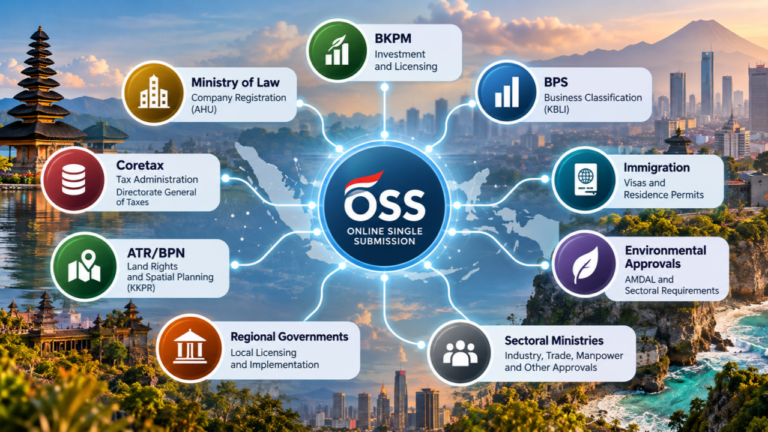
▪️ OSS Business Registration Restrictions: Online Single Submission (OSS) portals halted new foreign-owned company (PT PMA) registrations across 18 low-risk commercial classifications.
Closing quick shortcuts enforces market transparency. Establishing a proper corporate structure is no longer an optional recommendation, it is the baseline requirement for commercial operations.
Moving Beyond Commercial Shortcuts to Authentic Compliance
Debates surrounding foreign investment often focus on which business classification codes (KBLI) remain open to foreign capital. However, individual codes are rarely the core issue; the true challenge lies in reliance on administrative shortcuts.
Common operational shortcuts facing scrutiny under business legal enforcement in Bali include:
▪️ Relying on virtual office addresses without physical commercial premises
▪️ Registering low-risk business classifications to operate high-impact commercial resorts
▪️ Renting residential villas as short-term holiday accommodations without hospitality permits
▪️ Utilizing local nominees on land title certificates to bypass foreign ownership limits
When enforcement remains lax, informal operators pay less and undercut compliant businesses. When enforcement becomes systematic, full compliance becomes the primary operational protection.
Proper compliance establishes market fairness, protects reselling value, and confirms that foreign capital contributes positively to Bali’s long-term economic stability.
Infrastructure Challenges Impacting Long-Term Investment Yields
Future real estate yields depend on infrastructure capacity as much as legal licensing. Regional sustainability challenges require proactive investment strategies:
— Water Table Depletion
Unmetered commercial wells have caused groundwater tables to drop over fifty meters in specific districts within a decade. Saltwater intrusion now threatens freshwater aquifers along the southern coast. Resort operations require verified water access agreements to mitigate supply risks.
— Solid Waste Processing Limits
Denpasar’s primary Suwung landfill ceased accepting organic waste, pushing municipal authorities toward localized processing centers. Property developments must incorporate sustainable waste management procedures to maintain operational viability.
— Agricultural Land Conversion and Flood Risks
Annual conversions of agricultural land reduce natural rainwater absorption. Heavy rain events demonstrate that concrete development without adequate drainage increases localized flood exposure.
— International Air Traffic Dependencies
Long-haul tourist arrivals rely heavily on Middle Eastern transit hubs. External airspace disruptions immediately impact long-stay European and Middle Eastern market segments, shifting short-term market reliance toward regional short-haul origin markets like Australia.
What the Regulatory Shift Means for Property Investors
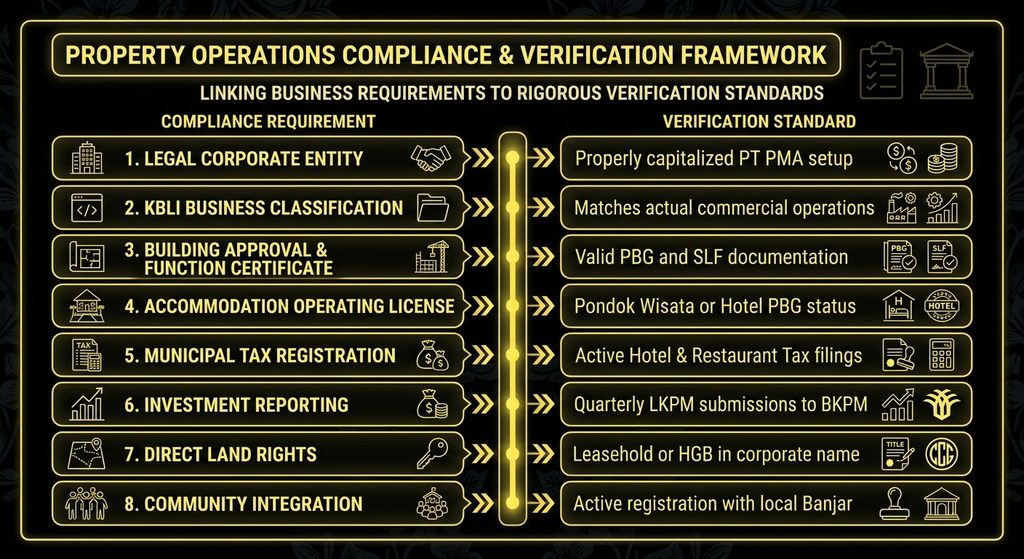
Understanding how business legal enforcement in Bali impacts property ventures is essential for establishing clear, defensible corporate foundations that survive long-term audits.
Market trajectories indicate three definitive trends:
1. Stabilized Arrival Numbers: Emphasis will remain on increasing average yield per visitor rather than pursuing exponential arrival growth.
2. Systematic Enforcement: Inspection focus is shifting from new corporate registrations to auditing legacy operational structures and nominee arrangements.
3. Geographic Diversification: Commercial property development is expanding beyond saturated southern districts toward northern and eastern coastal corridors as road infrastructure improves.
Ensuring every property asset holds verified building approvals, accurate KBLI classifications, and direct corporate leasehold titles prevents sudden administrative closures.