Thirty years in Bali teaches you to read Indonesian law the way you read tide charts—slowly, suspiciously, and never at face value.
When the House of Representatives (DPR) began deliberations on the new draft revision to the Indonesian Citizenship Law (Law No. 12/2006), I read it twice: once for what it explicitly states, and once for what it leaves unaddressed.
On the surface, the proposed amendments mark a historic shift.
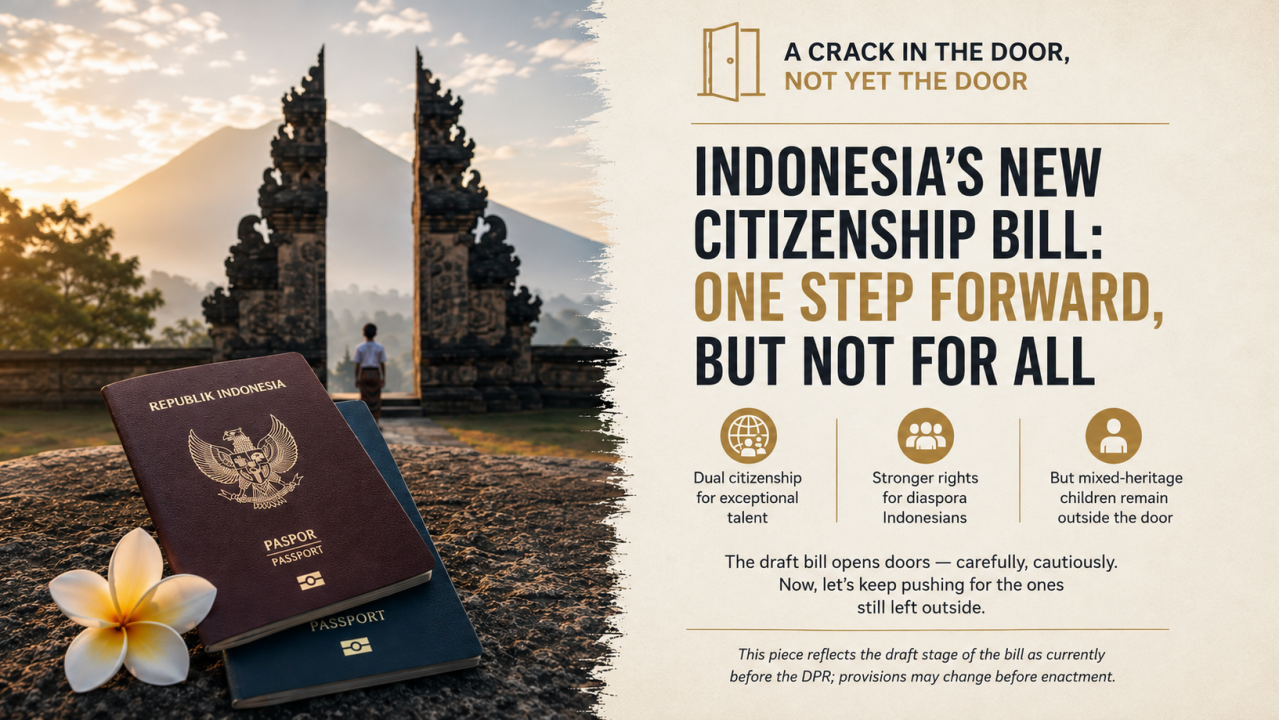
For the first time, Indonesia is willing to let a foreigner keep two passports. Not any foreigner. A narrow class – scientists, technologists, economic contributors – “exceptional service to the state,” granted by the President, blessed by the DPR. Under the old law, that same person had to give up everything to become WNI. Full renunciation. No exceptions. Now there’s a door. A narrow one. Guarded. But a door.
And alongside it, a diaspora regime with actual teeth – banking access, property rights, the right to set up a business entity, a simplified path back to full citizenship for those who left and want to come home. Former WNI and their descendants, up to the second generation. That’s not nothing. That’s Jakarta admitting, quietly, that the people who left didn’t stop being useful.
I want to sit with that for a moment, because it matters.
For decades the assumption baked into Indonesian nationality law was binary. You are WNI or you are not. You chose, at eighteen, and the state moved on without you.
This bill is the first real acknowledgment that identity doesn’t work that way for a country with this many people scattered across this many borders. It is incremental. It is cautious. It is very, very Indonesian in its caution.
But here’s where I put the pen down and think about the kids.
Not abstractly. I know these kids. Half-Indonesian, half-something-else. Born in Indonesia, or born abroad to a Indonesian mother or father and a foreign mother or father, raised bilingual, raised between two flags, who turned eighteen and had to pick one – because Indonesia doesn’t allow dual citizenship for its own children past the age of majority, and this bill does nothing to change that for them. I have three kids myself in this situation.
Here is the gap, plainly:
– The diaspora, as this bill defines it, means former WNI and their descendants to the second degree.
– A mixed-heritage child who never held WNI status – because a parent chose the foreign passport for them, or because they were simply born outside the citizenship line – is not diaspora in the eyes of this law.
– No banking facility. No simplified reacquisition. No business entity rights by virtue of blood.
– They are, legally, just another foreigner. Despite the Indonesian name. Despite the childhood home. Despite the language they still dream in.
That’s the part of this bill I can’t celebrate without qualification.
The exceptional-talent provision is generous to strangers who arrive with the right credentials. The diaspora provision is generous to those who once held the little maroon passport and let it go. But the child of a mixed marriage who was never handed that passport in the first place – who has no “former” status to reclaim – sits outside both categories. Not foreign enough to be courted as talent. Not Indonesian enough, on paper, to be welcomed home.
I don’t think this is malice. I think it’s the limit of how far the drafters were willing to go in one bill. Dual citizenship for exceptional foreigners is a controlled experiment – small numbers, presidential discretion, easy to monitor. Full dual citizenship for Indonesia’s own diaspora children, including the ones raised abroad or raised mixed, is a much bigger political conversation, and this bill is clearly not trying to have it yet.
So where does that leave us.
One step closer, genuinely, to a country that might one day let its own hold two passports without shame. The taboo is cracking. The language of “limited dual citizenship” is now in a government draft, which five years ago would have been unthinkable.
But not there yet. Not for the ones who need it most – the children who never chose their in-between, who inherited it.
I’ll keep watching this bill through committee. I’d rather be wrong about how far it goes than right about how little it changes. For now, my honest read: welcome the diaspora provision, welcome the talent exception, and keep pressing – publicly, loudly – on the mixed-heritage gap this draft leaves standing.
This piece reflects the draft stage of the bill as currently before the DPR; provisions may change before enactment.