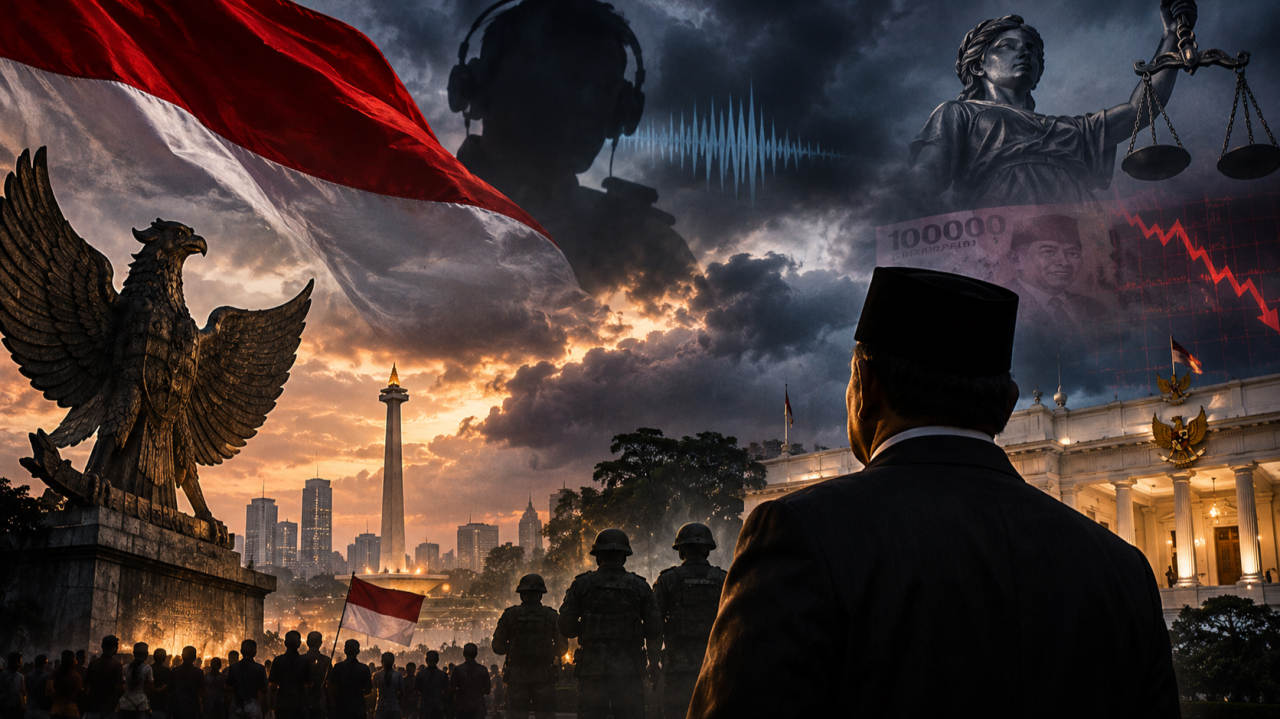
Secret recordings, a Vice President in trouble, a falling currency, and a nation that keeps choosing to stand
Eight Decades of Storms
To understand the trouble this autumn, we must first remember the storms this nation has already survived.
Indonesia wasn’t handed a ready-made state. It had to build one, watch it fracture, and piece it back together—repeatedly. Every time a new government took over, the laws shifted to match the new leader.
1945: Merdeka
On August 17, Sukarno and Hatta declared independence. The 1945 Constitution was adopted just a day later. The new nation had to untangle itself from Dutch colonial laws—which treated “natives” and “Europeans” differently—and forge its own legal identity.
1945 to 1949: The Fight for Recognition
Four tough years of revolution and diplomacy followed. Finally, on December 27, 1949, after a major conference in The Hague, the Netherlands officially handed over power. Freedom had been declared; now, the world acknowledged it.
1950s: Democracy, Rebellion, Exile
A decade of parliamentary democracy eventually fractured into regional uprisings, leading to Sukarno’s Guided Democracy in 1959. It was during this period that Sumitro Djojohadikusumo—Prabowo’s father—was branded a rebel and forced into exile.
1965: The Darkest Year
The events of September 30, 1965, and the mass killings that followed remain the deepest scar in modern Indonesian history. From that chaos, Suharto rose to power, officially becoming president in 1967.
1966 to 1998: The New Order
Three decades of stability and economic growth—but also three decades where the law served order more than justice. Legal systems were built for the elite, while human rights and anti-corruption efforts were sidelined.
1998: Reformasi
The Asian financial crisis crashed the rupiah, and then the regime. In May 1998, after riots and student protests, Suharto resigned. A legal revolution followed: a human rights law in 1999, four rounds of constitutional changes between 1999 and 2002, an anti-corruption commission, a Constitutional Court in 2003, a free press, and presidential term limits.
2004: The People Choose
For the first time, Indonesians directly elected their president. Susilo Bambang Yudhoyono’s decade in office prioritized democracy, development, stability, and judicial reform.
2014 to 2024: Jokowi
A focus on infrastructure, investment, and social welfare. The economy was opened up, though lingering questions remained about institutional independence and the rise of political dynasties.
2024: Prabowo
The former general who lost as a running mate in 2009—and twice more as a presidential candidate—finally won, with the previous president’s son beside him.
Look at that list again.
Independence. Revolution. Rebellion. Massacre. Dictatorship. Collapse. Rebirth.
To the people who lived through those moments, each one felt like the end of the world. But it never ended.
Every single time, Indonesia found a way through, and every time, its laws and institutions came out a little more uniquely Indonesian. That is the lens through which I view the storm of 2026.
The Test Has Arrived
Just over a year ago, I wrote that Prabowo Subianto’s biggest fight would not be with his critics, but with his own past. I ended that piece with a fundamental question: Will he be a healer, or a repeat of history?
Back then, it seemed like a question for the history books. Something that would be answered slowly, over a full term, through budgets, appointments, and the quiet tone of a presidency.
It did not stay quiet.
In just a few weeks this autumn, Indonesia has witnessed a former national police chief arrested for allegedly tapping the President’s own phone. It has watched the Supreme Court invalidate the school-equivalence certificate of the sitting Vice President, who then walked into the palace to offer his resignation. It has seen over twenty thousand soldiers deployed into Jakarta. And all of this is unfolding against a rupiah that has hovered near its weakest historical levels for most of the year.
Any single one of these events would dominate national headlines. Combined, they feel like a perfect storm. Having lived in this country for over thirty years, I was here in 1998 when the storm was real and the state nearly fractured. I remember the terrifying reality of institutional failure: when the streets took control because no one else could.
This is not that.
Struggle for the Soul of the Republic
What I witness in November 2026 is something more complex, and perhaps more hopeful. It is a battle over the ownership of the Indonesian state. It is a fight over whether the police, the courts, the treasury, and the highest offices serve the republic and its citizens—or merely serve the private loyalties of whoever happens to occupy them.
It is a brutal spectacle to witness. But it is, at its core, a struggle. And a republic that retains the strength to fight for its own soul is a republic that is far from lost.
This piece is longer than my last. The moment demands it. I want to walk through what is actually happening, what it means, what could still go wrong, and why, despite all of it, I believe Indonesia will find its way.
The Phone That Was Listening
On the night of Tuesday, November 3, the head of the National Police’s Criminal Investigation Agency, Asep Safrudin, stood before the press and said something few Indonesians ever expected to hear.
That the President had been listened to. Not by a foreign power. Not by a hacker in some distant country. But by senior officers of his own police force.
At the center of the allegations is General Listyo Sigit Prabowo. He led the National Police for five years, appointed in 2021 by President Joko Widodo, and before that served as police chief in Solo while Jokowi was its mayor. In October, he was moved out of the police and into the palace as the President’s chief of staff—a shift many observers saw as a demotion.
A month later, he was arrested. Police allege that he and other senior generals ordered phone taps between 2025 and 2026 without following the procedure set out in a 2010 police regulation.
According to the investigators, the targets were not only the President but also state officials, political figures, media figures, community leaders, NGO activists, and businesspeople. It is also alleged that the files gathered were deleted last month.
The next day, Prabowo dismissed his chief of staff. His spokesperson, Prasetyo Hadi, said the acts may fall into the category of those tending towards treason. Gerindra’s secretary-general, Sugiono, called it insubordination within the government. Over the following days, the military began moving more than twenty thousand personnel into the capital—at first saying the deployment should not be linked to other issues, and later citing a range of threats including treason.
Then the state did something that matters more than the headlines. It started fixing the plumbing.
On November 9, Coordinating Minister for Law Yusril Ihza Mahendra announced that the government would tighten controls on state surveillance equipment and consider sweeping the presidential palace for bugging devices. Over the weekend, Prabowo had met with ten former national police chiefs to discuss the case.
It is important to be careful here, because careful is what this moment requires.
No formal charges have yet been announced. Police have not named a motive. They have not said who, if anyone, received what was collected. Everything I have described is an allegation under investigation, and every person named is entitled to their day in court.
But look at the shape of what happened.
A police force investigated, and arrested, its own former chief. The government named the problem in public instead of burying it. And the first policy response was not a crackdown on critics, but a promise to control the spying tools themselves.
Amnesty International Indonesia’s Usman Hamid made the point that should guide all of us: this is not merely about the President’s phone. An apparatus that can quietly listen to presidents can also listen to journalists, activists and ordinary citizens, and can be used to intimidate them.
He is right. Which is exactly why the outcome of this case matters far beyond the palace.
If it ends with a few officers punished and the machinery left intact, it will be remembered as a palace feud.
If it ends with real, legislated limits on who may tap whose phone, and with independent oversight of those who do, it will be remembered as the moment Indonesia took its surveillance state back from the shadows and placed it under law.
That is the battle inside this scandal. Not Prabowo against one general. The republic against the idea that the instruments of the state can be used as private property.
The Vice President and the Paper That Was Not There
While the wiretap story broke, a second one was reaching its climax.
It began years ago as something almost trivial: a certificate of educational equivalence, issued in 2019, confirming that Gibran Rakabuming Raka’s schooling abroad equaled an Indonesian senior high school diploma. A document that sat quietly in a file until he became a candidate for the second-highest office in the land.
Then it became the most expensive piece of paper in Indonesia.
On October 6, the Constitutional Court ruled on a petition challenging his eligibility. It declared the case inadmissible because the petitioners lacked legal standing. It did not remove him. It did not say he had failed to finish school.
But it noted, in plain language, that the hearing had produced no convincing evidence, no diploma or foreign certificate, that could confirm his high-school equivalence.
The door was left open.
On October 30, the Supreme Court walked through it. In case 742 K/TUN/2026, it granted a cassation petition against the equivalence certificate itself. Yesterday, November 10, the full ruling was released, ordering the education ministry to revoke the certificate. Separately, the police criminal investigation agency opened an inquiry on October 16 into a report alleging forgery in his candidacy documents.
And on the morning of November 10, Gibran sat down with the President and expressed his intention to resign.
The palace has been careful. State Secretary Prasetyo Hadi said Gibran remains Vice President, that the President offered advice in return, and that it was untrue the President had rejected the offer. The parties are restless, and some openly talk of impeachment, though many remain hesitant to lead it. One party secretary-general put it bluntly: end this drama as soon as possible.
I will not pretend to know how this ends. But consider, again, what has actually happened.
A Constitutional Court looked at the son of a former president, the sitting Vice President, and said on the record that the evidence was not there.
The Supreme Court then ruled against his certificate, knowing exactly whose certificate it was.
And the man at the center of it is, at least for now, talking about resignation rather than defiance.
In many countries, that sequence would be unthinkable. In the Indonesia of a decade ago, it might have been, too.
The Constitution already has the answer to what comes next if he goes. Under Article 8 of the 1945 Constitution, if the vice presidency falls vacant, the People’s Consultative Assembly elects a replacement from two candidates nominated by the President, within sixty days. No emergency. No improvisation. A rule written long ago, waiting for exactly this.
That, too, is a quiet victory. The question was never really about one diploma.
It was about whether the rules for high office apply to everyone, including those with the most powerful surnames in the country.
This autumn, the courts answered. The rules apply.
Two Men, One Shadow
It is impossible to write about any of this without writing about two men.
In 2019, Prabowo lost to Joko Widodo, accepted it, and joined his cabinet. In 2024, he won the presidency with Jokowi’s eldest son beside him as running mate. It was one of the most remarkable reconciliations in modern Indonesian politics.
I praised it at the time. I still believe it was right for the country. But alliances built for winning elections are not always built for governing.
The threads that tie this autumn’s stories together keep leading back to the same place:
▪️ The general accused in the wiretap case was Jokowi’s choice as police chief, and his police chief in Solo before that.
▪️ The Vice President under legal cloud is Jokowi’s son.
▪️ On November 5, as the wiretap scandal raged, Jokowi himself sat in the East Jakarta District Court, under heavy security, testifying as a witness in the defamation trial over claims that his own university diploma is fake.
Analysts now speak openly of a growing rift between Prabowo and his predecessor. They point to cuts in funding for Nusantara, the new capital that was Jokowi’s signature project, and to a sense that Gibran has been sidelined. One respected political scientist, Burhanuddin Muhtadi, warned that if it is not handled well, this could be just the beginning of a larger escalation.
Jokowi’s own response to the wiretap case was five words: we are respecting the process.
I want to be very clear about one thing.
Nothing has been proven against Jokowi. No investigator has accused him of anything in the wiretap case. A former president is not guilty because a man he once promoted is accused of a crime, any more than a father answers in court for his son’s paperwork.
And yet the political reality cannot be wished away.
For ten years, much of Indonesia’s state was shaped by one man’s appointments, one man’s networks, one man’s idea of loyalty. A new president now sits atop that structure. Some of its pieces are loyal to the office. Some, perhaps, remain loyal to the person who placed them there.
Every democracy that hands power from one strong leader to another goes through this. The question is not whether there will be friction. The question is whether the friction is settled by law, or by force.
So far, and I say this with cautious relief, it is being settled in courtrooms, in police investigations, in parliamentary debate and in palace meetings. Not in the streets.
The troops in Jakarta make many people nervous, and they should keep us watchful. But they have not been turned on the public. If the state is serious about reform, they must never be.
The Rupiah, the Ledger and the Kitchen Table
Politics makes headlines. Money decides how people live. And 2026 has been a hard year for Indonesian money.
It began badly. In late January, the index provider MSCI warned that Indonesia’s stock market could be downgraded from emerging to frontier status over concerns about liquidity and transparency.
The market suffered its worst two-day fall since 1998. Days later, on February 5, Moody’s kept Indonesia’s investment-grade rating at Baa2 but cut its outlook to negative, citing reduced predictability in policymaking.
Then the world added its own weight. War in the Middle East pushed energy prices up. In early June, the rupiah broke through 18,000 to the US dollar for the first time in its history. By late June, the stock market had lost about a third of its value for the year. Into late October and early November, the currency was still trading around 18,100, close to its record lows, even as some regional currencies strengthened.
The treasury has felt it, too.
The 2026 budget was planned with a deficit of 2.68 percent of GDP. The finance ministry now expects 2.85 percent, about Rp 734 trillion, as disaster relief and energy subsidies push spending above plan. That is close to the legal ceiling of 3 percent. Close, but still under it.
And there has been turbulence at the top. When Sri Mulyani Indrawati resigned in September 2025 after weeks of unrest, Purbaya Yudhi Sadewa took over with promises of bold growth.
On September 14 this year, he too was replaced, by his deputy Suahasil Nazara: the third finance minister in two years. Suahasil, a careful technocrat who has served at the ministry since 2019, pledged a healthy and credible budget.
For investors, these are warning lights. For ordinary Indonesians, they are something more immediate:
▪️ Imported goods that cost more.
▪️ Fuel and food prices that creep upward, with inflation reaching 3.28 percent in September.
▪️ Business owners who delay hiring.
▪️ Families who stretch the same rupiah a little further each month.
I see it here in Bali every day. In conversations with business owners. In the hesitation of investors who were ready to commit a year ago and now want to wait and see. But I also see the other side of the ledger, and it deserves to be told.
The economy grew 5.11 percent last year. Foreign exchange reserves stood at around US$146.5 billion at the end of August, enough to cover more than five months of imports and government external debt. The central bank has been intervening steadily to steady the currency. The deficit, though wider, remains inside the line the law draws. Indonesia is still investment grade with every major rating agency. This is not 1998.
In 1998, the rupiah lost most of its value in months, the banking system collapsed, and the state had no buffers left. Today, the buffers are thinner than anyone would like. But they are there.
What Indonesia faces is not a collapse. It is a crisis of confidence: a question in the minds of investors about whether policy will be predictable, whether institutions will be respected, and whether ambitious programs will be paid for responsibly.
And here is the point that links the economy to everything else in this piece.
Confidence is not built by currency interventions alone. It is built when markets see that the rules hold. When a police force can be held to account. When courts can rule against the powerful. When a finance minister is allowed to say no. The political battle and the economic battle are the same battle.
Battle for the State, and for Its People
Step back from the individual stories, and a single pattern appears. Indonesia is deciding who its state belongs to.
In my last piece, I wrote about Prabowo’s grandfather, Margono Djojohadikusumo, who founded Bank Negara Indonesia and believed the young republic should be built on institutions, not personalities. I wrote about his father, Sumitro, who warned against fiscal collapse and creeping authoritarianism, and paid for it with a decade in exile.
Both men understood something that every generation has to learn again.
A state is not a family estate.
It is not the reward of the winner.
It is a trust, held on behalf of people who will never sit in the palace.
That is what is at stake now:
▪️ The police: will they serve the law and the public, or the networks that appointed them?
▪️ The courts: will they rule on evidence, even when the evidence touches the powerful?
▪️ The treasury: will it be guided by sound numbers, or by political wishes?
▪️ The highest offices: will their requirements apply to everyone, whatever their surname?
This is a battle for the state. But it is also a battle for its people.
Because it is ordinary Indonesians who pay when a currency falls, when police power is abused, when public money is wasted, when an activist’s phone is quietly tapped. And it is ordinary Indonesians who gain when institutions are made clean and strong.
The farmer in Tabanan. The driver in Denpasar. The student in Makassar. The trader in Medan.
They do not care which faction wins in Jakarta. They care whether the state works for them.
In 1998, Indonesians won a hard lesson in the streets: that power without accountability eventually turns on the people it claims to protect. The generation of Reformasi wrote that lesson into a new constitutional order, with direct elections, a Constitutional Court, term limits and a free press.
This autumn, that order has been tested from every direction at once.
And it has held. Not perfectly. Not quietly. But it has held.
What Could Still Go Wrong
Optimism that ignores danger is not optimism. It is denial.
So let me be honest about the risks, because the people who doubted Prabowo a year ago were not wrong to ask their questions, and they are not wrong to ask them now.
The word treason is heavy. It has been used very quickly. In the hands of a fair process, it describes a real crime against the state. In the hands of an unfair one, it can become a tool to silence opponents. How the wiretap case is prosecuted, openly, on evidence, with full rights of defense, will tell us which one it is.
The soldiers must go back to their barracks. A deployment justified by threats can quietly become a habit. Indonesia spent decades separating the military from civilian politics. That separation is one of Reformasi’s greatest achievements, and it must not be traded away in a moment of anxiety.
A purge is not a reform. Removing the loyalists of one network only to install the loyalists of another would change the names but not the disease. The real test is whether the rules around surveillance, policing and appointments become stronger and more transparent, no matter who benefits.
The Vice President question must be settled by the Constitution, not by deals. Whether Gibran stays or goes, the process must be lawful, public and dignified. If it becomes a bargaining chip between political camps, the courts’ work will have been wasted.
The budget must face hard choices. Defense, free school meals, energy subsidies and disaster relief all compete for a deficit that is nearly at its legal limit. Markets will watch whether the new finance minister is given room to make difficult trade-offs, or whether politics overrules arithmetic.
And the fight between two powerful men must not consume the nation. Indonesia cannot afford years of rivalry between a sitting president and a former one, played out through police files, court cases and leaked recordings. At some point, the national interest has to be larger than either of them.
These are not small risks. But naming them is not pessimism. It is how a democracy protects itself.
Why Indonesia Will Find Its Way
So why am I hopeful? Not because the news is good. Much of it is not. I am hopeful because of what I have seen this country do before.
Indonesia has survived revolution and rebellion. It has survived hyperinflation in the 1960s and the collapse of 1998. It has survived dictatorship and found its way back to democracy. It has survived tsunamis, earthquakes, pandemics and more economic storms than I can count in my thirty-odd years here.
It bends. It does not break.
I am hopeful because the institutions are doing what institutions are meant to do. Courts are ruling. Investigators are investigating. Ministers are being held responsible. A sitting vice president is talking about resignation. A former president is answering questions under oath. These are not the signs of a state falling apart. They are the signs of a state trying, painfully, to hold its powerful to account.
I am hopeful because the fundamentals are still there. A young population of more than 280 million. Vast natural resources. A growing middle class. A strategic place in a world that badly needs stable partners. Reserves that can absorb shocks. An economy that, even in a hard year, is still growing.
And I am hopeful because of the people.
Indonesians have a quality that is hard to describe to those who have not lived here. A patience that is not passivity. A resilience rooted in community, in gotong royong, in the instinct to carry each other through hard times. In Bali, we call the balance between the seen and the unseen sekala and niskala. Politics is the sekala, the visible noise. But underneath it runs something steadier, a quiet national will that has always, in the end, chosen the republic over the faction.
A year ago, I asked whether Prabowo could transform command into compassion, and discipline into justice. That question is now being answered in real time.
If he lets the wiretap case run its full legal course, and turns it into lasting limits on state surveillance;
if he respects the Constitution on the vice presidency, whatever the outcome;
if he sends the soldiers home once the moment passes;
if he gives his finance minister room to do the unpopular, necessary things;
then this autumn will be remembered not as the season Indonesia nearly lost its way, but as the season it reclaimed its state.
The son of Sumitro would have completed the arc his family began.
Not as a strongman. As a steward.
The road ahead is not smooth. It rarely is here. But I have watched this country walk harder roads than this one.
It will find its way. It always has.
Editorial note: This piece reflects my personal view as a long-term resident of Indonesia. The wiretapping case remains under investigation, no formal charges had been announced at the time of writing, and all individuals named are presumed innocent. The legal position of the Vice President was still unresolved on November 11, 2026. Figures are drawn from official statements and news reporting available at the time of writing.