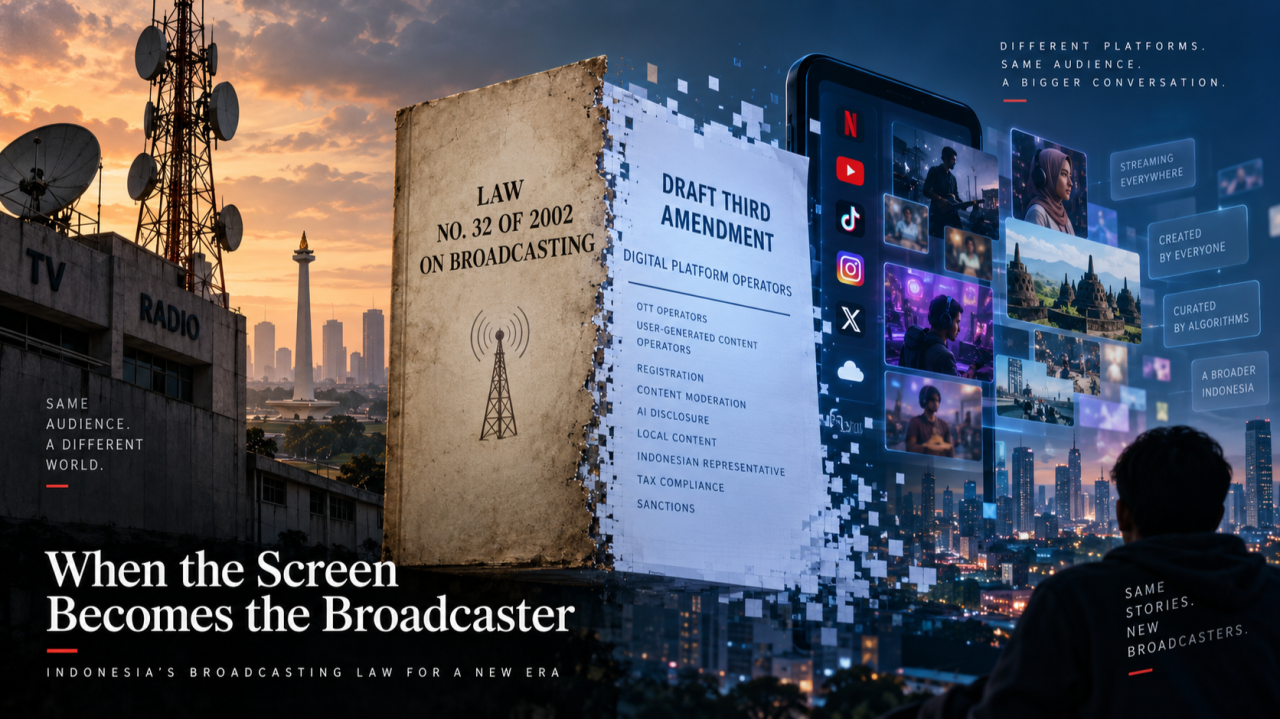
Jakarta is rewriting an old law for a medium it was never written for.
Law No. 32 of 2002 on Broadcasting was built for a different world. A world of transmission towers and licensed frequencies. A world where “broadcasting” meant something you could point to – a station, a signal, a studio with a sign on the door.
That world is still here. It just isn’t the whole picture anymore. Somewhere between 2002 and now, the broadcaster stopped being a building.
It became a platform. An algorithm. A feed that never sleeps, curated by code, filled by millions of people who never asked to be broadcasters and yet, in the eyes of an audience, are exactly that.
The Draft Third Amendment now moving through the DPR is Indonesia’s attempt to catch up with this shift. Not gently. Not at the margins. But by writing the words “Digital Platform Operator” directly into a broadcasting law that, until now, didn’t know such a thing existed.
What the law is trying to hold
Two categories, freshly defined:
▪️ Over-The-Top operators – the Netflixes, the streaming services, the curated catalogs
▪️ User-Generated Content operators – the platforms where the content isn’t curated by anyone, except by everyone at once
Both, under the Draft Bill, would need to register before they operate. Not after. Before.
Both would need to moderate. To filter. To take down what the law calls prohibited material – gambling, hoaxes, defamation, insults, damage to reputation – through mechanisms the law wants to see and can act against if they fail.
Both would need to disclose, in plain terms, when the content in front of a viewer was touched by artificial intelligence.
There is a particular weight placed on foreign OTT operators. A legal representative on Indonesian soil. A quarter of the content catalog reserved for local production. A dispute mechanism an Indonesian user can actually reach. Submission to Indonesian jurisdiction. Compliance with Indonesian tax law.
Read plainly, these are not small asks. They are the terms on which a foreign platform gets to keep speaking to an Indonesian audience at all.
The quiet part: consequences
Miss the registration deadline, and the sanction isn’t a fine tucked into a footnote. It’s suspension of service. It’s access blocking.
The same tools once reserved for a rogue television station now extend, in principle, to a platform with millions of daily Indonesian users. That is the real center of gravity in this amendment – not the registration form itself, but what happens when a company decides the form isn’t worth filling out.
I keep returning to one detail: the AI disclosure requirement.
Not because it’s the largest change in the Draft Bill – it isn’t – but because it’s the one that reaches furthest into the future.
Content moderation regulates what already exists. Registration regulates who’s allowed to operate. But disclosure of AI use is a bet on where content is going, made before the destination is fully visible.
Indonesia is not alone in making that bet. But it is choosing to make it now, inside a broadcasting law, rather than waiting for a dedicated AI statute to catch up on its own schedule.
Where this leaves an operator
Anyone running an OTT service, or hosting user-generated content, aimed at an Indonesian audience has homework now, not later:
▪️ Map current operations against the expanded definition of “broadcasting”
▪️ Build – or document – the moderation and takedown mechanisms the law expects to see
▪️ Prepare age-verification and child-protection systems where restricted content is involved
▪️ Decide, concretely, how AI-generated or AI-assisted content will be labeled
▪️ Assemble the registration documentation before the deadline exists, not after
None of this is exotic. Regulators elsewhere have asked for versions of the same things. What’s notable is the vehicle – an old broadcasting law, amended a third time, now reaching into territory its original drafters never imagined.
The law that once regulated towers and transmission frequencies is being asked to regulate feeds and recommendation engines.
Whether it can do that well — whether “broadcasting” is even the right word anymore for what a platform does – is a question the Draft Bill doesn’t quite answer. It just proceeds as if the answer is yes.