
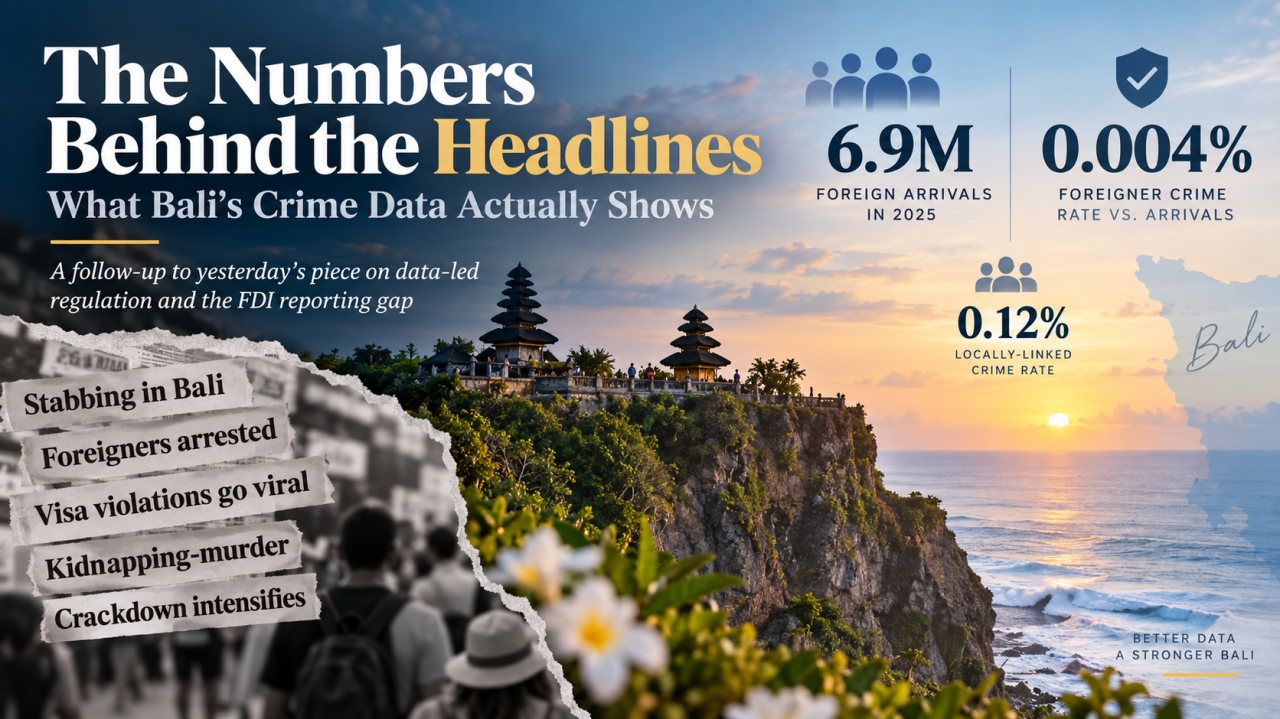
A follow-up to yesterday’s piece on data-led regulation and the FDI reporting gap
Yesterday’s piece argued that Bali’s investment problem is a data problem – that blanket enforcement against foreign investors is being applied where targeted, evidence-based regulation would do better.
The same argument holds, arguably even more starkly, when it comes to the parallel narrative driving policy right now: the idea that foreigners are a rising security threat to the island.
The headlines are relentless. Stabbings, shootings, a kidnapping-murder, viral videos of visa violations. Immigration crackdowns and joint task forces have followed. But headlines describe incidents, not rates.
Once the same numbers are set against the scale of foreign presence in Bali, and against how the island’s own population fares by the same measure, a very different picture starts to form.
The Raw Numbers
Foreigners involved in crime cases: Bali Police recorded 301 cases involving 309 foreign nationals between January and October 2025 – already surpassing the full 2024 total of 226 for the year. The figure covers foreigners in any role connected to a case; it isn’t broken out into suspects versus victims or complainants, which is itself a data gap worth flagging.
Deportations and detentions: Government data showed roughly 2,600 foreign nationals deported from Bali and another 2,000 detained between January and July 2025 alone – a sharp jump from the prior year. By comparison, only 165 deportations and 62 detentions were reported for the equivalent period in early 2026, suggesting either the crackdown’s early phase was unusually aggressive or reporting has since normalized.
Total foreign arrivals: Bali recorded more than 6.9 million foreign visits in 2025, about 44% of all international arrivals to Indonesia that year.
Total crime caseload and local population: Bali Police handled 5,721 criminal cases across the island in 2025, up 4.7% from 5,466 in 2024. Subtracting the ~301 foreigner-linked cases leaves roughly 5,420 cases connected to the resident population, set against a projected 2025 population of about 4.46 million.
What the Rates Actually Say
| Foreigners in crime cases ÷ foreign arrivals | ≈ 0.004% |
| Foreign deportations ÷ foreign arrivals | ≈ 0.04% |
| Locally-linked cases ÷ resident population | ≈ 0.12% |
Set side by side, the resident population’s case rate is roughly 30 times higher than the foreign visitor case rate, measured against each group’s own denominator.
This is not a claim that foreigners commit no crime, or that recent incidents weren’t serious – several were genuinely severe, and no rate calculation changes that. It’s a claim about proportion, and proportion is exactly what blanket enforcement policy discards.
A crackdown built on “foreigners are a growing problem” without reference to volume will always find a rising raw number, because arrivals themselves are rising. 6.9 million visits is not a stable base; more visits mechanically produces more incidents even if the underlying rate is flat or falling.
The Same Pattern as the PMA Problem
This lines up with yesterday’s argument almost exactly. There, the issue was that BKPM’s formal FDI figures miss the scale of real foreign capital flowing through Bali via leasehold structures – a measurement gap that lets policy react to an incomplete picture.
Here, the issue is closer to the opposite failure: raw incident counts are visible and get top billing, while the denominator that would make them meaningful – arrivals, population, exposure — rarely appears in the same sentence.
Both cases point to the same structural weakness: Bali’s policy response is being calibrated against numbers that are technically accurate but analytically incomplete.
The KBLI moratorium closed OSS access broadly, across sectors, rather than targeting the specific circumvention patterns the data shows. The immigration crackdown reads the same way – a broad-based response to a narrow-based problem, when the rate data suggests foreign visitors are, proportionally, a small share of Bali’s overall caseload.
How Bali Compares Internationally
Rate, not raw count, is also the right lens for benchmarking Bali against other major destinations grappling with the same “foreigners behaving badly” narrative.
The measurement methods differ by country — case counts, deportation counts, and visa cancellations aren’t strictly equivalent – but set side by side, the pattern is informative.
📌 Vietnam logged around 16,000 foreign nationals committing offences in 2024, spanning theft, fraud, drug offenses, cybercrime, and illegal gambling operations, against 17.6 million foreign arrivals that year – a rate of roughly 0.09%. Notably, Vietnamese police officials have stated that 2025’s foreign crime figures did not rise significantly even as arrivals surged past 21 million, a 20% jump.
📌 Australia recorded 948 visa cancellations on character or criminal grounds (Section 501) in FY2024–25, plus 846 refusals, against roughly 8.4–8.5 million international arrivals – a rate of about 0.011%. One caveat: Section 501 mostly captures longer-term visa holders – residents, students, workers – with criminal convictions, not short-term tourists, so it isn’t a perfect like-for-like with Bali’s foreigner-in-crime-case figure.
📌 Thailand doesn’t yet have a comparable published national baseline; deportation has historically been handled case-by-case rather than centrally tallied, and new national deportation rules only took effect in August 2026. The one available data point is sub-national: Phuket alone recorded 998 foreigners deported for criminal activity and 194 visa rescissions in 2024, mostly drug-related and illegal-work cases, against Thailand’s national total of roughly 33–35 million annual arrivals.
The headline framing treats Bali as a uniquely deteriorating case. The rate data doesn’t support that. Bali’s foreigner-crime rate sits below Vietnam’s and in the same broad range as Australia’s – a country not generally described as suffering a foreign-crime crisis.
If anything, Vietnam’s experience is the more useful precedent: a 20%+ surge in arrivals with no corresponding rise in the foreign crime rate suggests volume growth and misconduct rate are not mechanically linked, which is exactly the assumption blanket enforcement policy tends to make.
The Data Gaps That Remain
A few things the public data doesn’t yet answer, and probably should before either policy debate goes further:
▪️ Suspect vs. victim breakdown. The 301/309 figure doesn’t say how many foreigners were reported against versus how many were reporting a crime committed against them. These are policy-relevant in opposite directions.
▪️ Deportation grounds. “Deported” spans everything from overstay administrative violations to serious criminal conduct – treating these as one category obscures more than it reveals.
▪️ Comparable time windows. Arrival figures, deportation figures, and case figures are reported on inconsistent periods (calendar year, 7-month windows, 10-month windows), making apples-to-apples comparison harder than it should be for a policy question this consequential.
Until those gaps close, both the investment-regulation debate and the security-enforcement debate are running on the same flawed foundation: real numbers, wrong resolution.
Sources: Bali Regional Police (via Antara News, October 2025); BPS-Statistics Indonesia Bali Province population projections; Bali Discovery (Bali Police year-end 2025 data); Jakarta Globe and VOI reporting on immigration deportation/detention figures, April 2026; Arab News, May 2026.