Why the Rules Are Changing Again
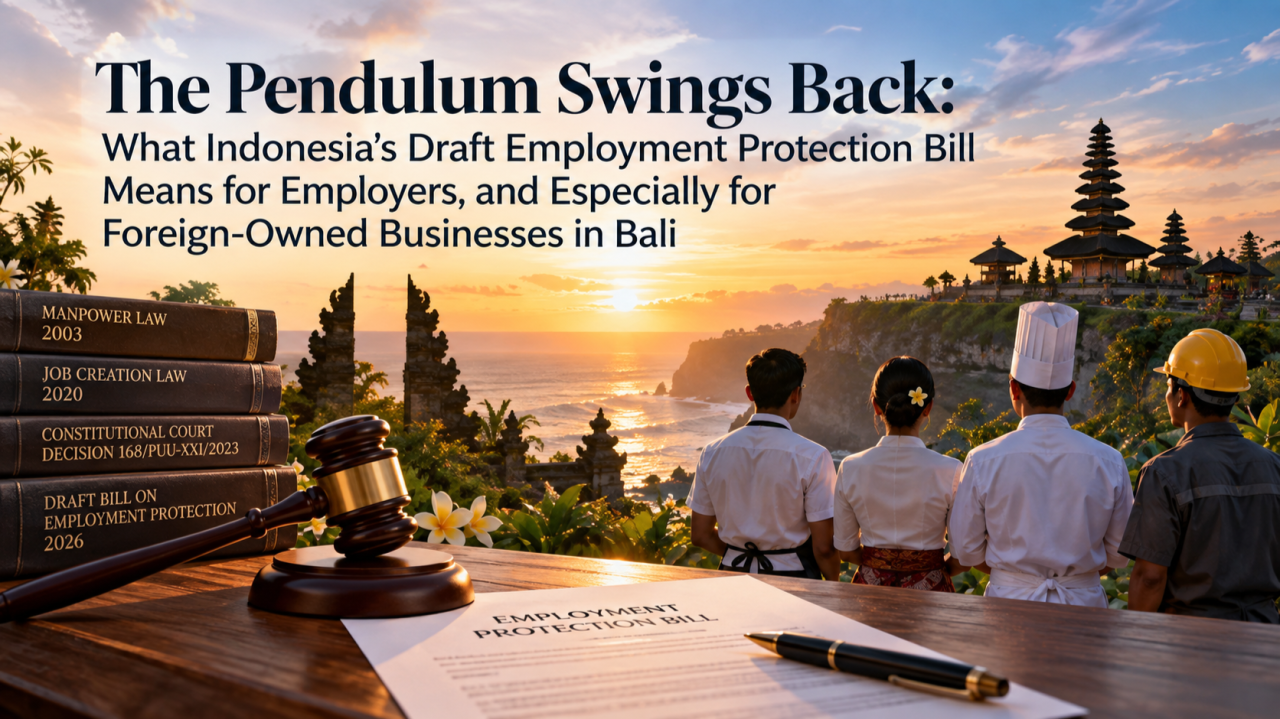
Indonesia’s employment framework has moved through several major shifts in two decades. The 2003 Manpower Law was strongly worker-protective. The 2020 Job Creation Law introduced greater flexibility to support investment and ease of doing business.
Then, Constitutional Court Decision No. 168/PUU-XXI/2023 directed lawmakers to place core employment rules back into a standalone statute rather than leaving them to implementing regulations.
That direction has now produced the Employment Protection Law. The legislation replaces the employment cluster previously contained in the Job Creation Law, while the 2003 Manpower Law continues to apply where it does not conflict with the new framework.
For employers in Bali, especially PT PMA companies operating villas, restaurants, beach clubs, construction businesses, and service companies, the changes are not merely administrative. They affect hiring structures, outsourcing, dismissals, severance exposure, wages, foreign-worker compliance, and potentially directors’ personal criminal risk.
Fixed-Term Contracts Become Shorter and More Visible
Fixed-term employment agreements, or PKWT, are widely used across Bali’s tourism and hospitality sector. The new framework tightens their use considerably.
Under the approved law, a PKWT is limited to a maximum of four years. The initial contract may run for two years, with no more than two extensions, each limited to one year.
Employers will also face stricter administrative requirements:
▪️ Written notice of an extension must be given at least seven days before the existing PKWT expires.
▪️ Every PKWT must be registered online with the manpower authority within three working days of signing.
▪️ Employees and labour inspectors can access the registration data.
▪️ PKWT arrangements are intended only for temporary, seasonal, new-product or new-activity work, or other time-bound roles—not permanent positions.
The practical risk is significant. If a PKWT is used for work that is genuinely permanent, or if administrative requirements are not met, the arrangement may convert into a permanent employment contract, or PKWTT. That conversion brings stronger termination protections and severance obligations.
For Bali businesses, the seasonal category may still help tourism operators. But long-running contract staff—such as front-office managers, head chefs, villa supervisors, and recurring operational roles—may be difficult to justify as temporary workers, particularly now that online registration makes repeated renewals easier for inspectors to identify.
Outsourcing Returns to a Restricted List
Outsourcing has also come full circle. The 2003 framework limited it to supporting activities, the 2020 reforms removed many restrictions, and the Constitutional Court later required outsourcing to remain limited to supporting functions rather than core business activities.
The new law maintains a closed list of permitted outsourced work. Reported categories include cleaning services, catering, security services, driver provision, operational support services, and support work in mining, oil, gas, and electricity.
The key uncertainty is transition. The available reporting does not clearly explain whether existing outsourcing contracts outside the permitted categories must end immediately, continue until expiry, or receive a transition period.
For Bali employers, this makes an outsourcing audit essential. Businesses using labour suppliers for maintenance, gardening, pool care, guest services, call-centre support, or back-office functions should map every arrangement now. Functions outside the permitted list may need to be brought in-house through PKWT or PKWTT arrangements, potentially increasing employment costs.
Dismissals Require a Final Decision
The most consequential change for employers concerns termination. The new framework restores the principle that an employer cannot unilaterally end an employment relationship without following the statutory dispute-resolution process.
The expected sequence is:
▪️ Bipartite negotiation.
▪️ Industrial relations dispute settlement.
▪️ A final and binding decision.
▪️ Termination.
A dismissal carried out without agreement or without a final and binding decision may be null and void by law. This concept existed under the 2003 Manpower Law, was removed in 2020, and has now returned.
Process wages also return. Until a dispute reaches a final outcome, the employer may need to continue paying wages and other employment entitlements. In practice, a contested dismissal can no longer be handled as a simple notice-and-departure process.
This makes strong documentation, warning letters, clear performance records, and negotiated exits far more valuable than before.
Severance Costs Rise With the Return of the 15% Component
The core severance structure remains broadly familiar:
▪️ Severance pay, or UP, generally ranges from one to nine months’ wages depending on length of service.
▪️ Long-service pay, or UPMK, generally ranges from two to ten months’ wages.
▪️ Compensation of rights, or UPH, covers items such as unused leave, repatriation costs, and other contractual entitlements.
The major change is the reinstatement of the 15% housing, medical, and healthcare compensation, calculated on severance pay and/or long-service pay. The 2020 regime had removed this component.
For employers, this increases the cost of every qualifying exit. Companies carrying severance provisions in their accounts, preparing for a sale, restructuring, or assessing termination exposure should recalculate their liabilities now.
A New Severance Guarantee Program Adds Another Cost Layer
The law also introduces a severance guarantee program to be administered through BPJS Ketenagakerjaan. It is intended to protect workers who lose their jobs when an employer becomes insolvent or unable to pay statutory entitlements.
The proposed mechanism works as follows:
— Employers register employees and pay contributions.
— BPJS pays guarantee benefits when termination occurs.
— If the benefit is lower than the statutory severance entitlement, the employer pays the difference.
— If the benefit exceeds the employer’s statutory obligation, the excess is returned to the employer.
Importantly, this is not a private insurance policy that removes severance from the employer’s balance sheet. It is an additional contribution, while the employer remains responsible for any shortfall.
The contribution rate, calculation method, collection process, and payment procedures still depend on implementing regulations.
Minimum Wages Gain New Layers
The new framework restores a more layered wage structure. Governors must set both provincial minimum wages, or UMP, and regency or city minimum wages, or UMK. The UMK must be higher than the UMP.
Minimum wages are to be determined using decent living needs, economic conditions, and employment conditions.
A new sectoral minimum wage is also introduced. It must be at least 5% above the applicable UMK and is intended for leading sectors, sectors with particular characteristics or risks, and sectors requiring specialisation.
For Bali, tourism and hospitality are obvious candidates under any practical reading of “leading sector.” Whether Badung, Gianyar, or Denpasar ultimately applies a hospitality sectoral wage at UMK plus 5% will depend on how the qualifying criteria are defined and how regional political priorities develop.
Wage Structures Must Be Negotiated
Today, employers generally prepare a wage structure and scale, communicate it, and attach it to company regulations. The new law changes this into a negotiation process.
Employers will need to negotiate the wage structure and scale with employee representatives and/or trade unions before attaching it to the Company Regulation, or PP, or Collective Labour Agreement, or PKB.
This shifts pay architecture from a management decision to a bipartite process. It may improve transparency, but it can also create delays or deadlock when agreements come up for renewal.
Digital Platform Workers Receive Formal Recognition
The law formally recognises ride-hailing drivers, app-based couriers, and other workers who obtain work through digital platforms. It acknowledges that their work is flexible and algorithm-driven rather than a conventional employment relationship.
The framework provides basic protections, including:
▪️ Social security coverage.
▪️ Reasonable income for work performed.
▪️ Occupational safety and health protections suited to the work.
▪️ Transparency regarding algorithmic changes affecting task allocation, performance ratings, and pay.
▪️ Protection against account deactivation or partnership termination without clear grounds and an objection mechanism.
▪️ The right to form trade unions.
However, the law does not yet establish minimum income standards, working-hour limits, a dedicated dispute mechanism, or a clear dividing line between partnership and employment. Further details are expected through separate legislation.
Foreign Workers Face Stricter Approval and Compliance Requirements
This section is especially relevant for Bali PMA companies employing expatriates, foreign directors, or foreign technical staff.
The law confirms that an approved foreign worker placement plan, or RPTKA, is a mandatory prerequisite before employing a foreign worker. It is an approval, not merely a notification.
Employers without an approved RPTKA may face progressive administrative sanctions: reprimand, written warning, fine, business restrictions, suspension, and ultimately revocation of the business licence.
Other obligations include:
— Maintaining Indonesian counterpart employees.
— Providing training connected to the foreign worker’s role.
— Facilitating Indonesian-language training for foreign workers.
— Ensuring certain foreign workers involved in technology and skills transfer hold an Indonesian-language competency certificate.
— Continuing the foreign worker compensation fund, or DKPTKA, subject to exemptions for certain institutions, social and religious organisations, and foreign workers with specified family ties to Indonesian citizens.
For employers, this means expatriate onboarding may become slower and more expensive. More importantly, a missing RPTKA is no longer simply a fine—it can ultimately put the company’s operating licence at risk.
Disability Employment Quotas Become Routine Compliance
The law also reinforces disability employment quotas. Government bodies, state-owned enterprises, and regional government-owned enterprises must ensure that at least 2% of their workforce consists of workers with disabilities. Private companies must meet a minimum quota of 1%.
Employers must also provide protection suited to the type and degree of each worker’s disability. Although these quotas already exist under Indonesia’s disability law, incorporating them into the employment framework makes them part of routine labour compliance.
Criminal Exposure Becomes a Director-Level Risk
One of the most important changes is the expansion of criminal sanctions. The law aligns with the new Criminal Code by setting maximum penalties and using category-based fines, ranging from Category I at IDR 1 million to Category VIII at IDR 50 billion.
New or expanded offences include:
▪️ Failing to register employees for BPJS social security: up to four years’ imprisonment and/or a Category V fine.
▪️ Withholding employee diplomas or personal documents as security: up to four years, subject to an exception for qualifications funded by employer training under a written agreement.
▪️ Paying wages contrary to agreed terms: up to four years.
▪️ Paying below the minimum wage: up to four years.
▪️ Union busting: up to five years.
▪️ Violating maternity leave rights: up to four years.
▪️ Worst forms of child labour: up to 15 years, increased from a previous five-year maximum.
This turns BPJS compliance from a back-office task into a potential director-level criminal risk. For smaller foreign-owned businesses in Bali, incomplete BPJS registration is one of the most common gaps—and one of the easiest to correct before enforcement begins.
What Bali Employers Should Do Now
The direction is clear: higher labour costs, less contractual flexibility, greater visibility for regulators, and stronger personal exposure for employers.
A practical starting point is to:
— Review every PKWT and assess whether the role is genuinely temporary, seasonal, or time-bound.
— Map all outsourced functions against the permitted categories.
— Recalculate severance exposure, including the reinstated 15% component.
— Audit BPJS registration for every employee, without exception.
— Confirm RPTKA approval, Indonesian counterpart arrangements, and training obligations for every foreign worker.
— Strengthen termination documentation, warning letters, performance records, and negotiated-exit procedures.
The law will continue to be interpreted through implementing regulations and practice. Businesses that prepare early will be better positioned to manage costs, reduce disputes, and avoid compliance surprises.
This article provides general information and does not constitute legal advice.