Jakarta, August 14. Friday morning.
Parliament sits. The cameras roll. Gibran listens from his seat beside the podium. Somewhere in the room, Jokowi watches the man who succeeded him deliver a speech neither of them could have written the same way.
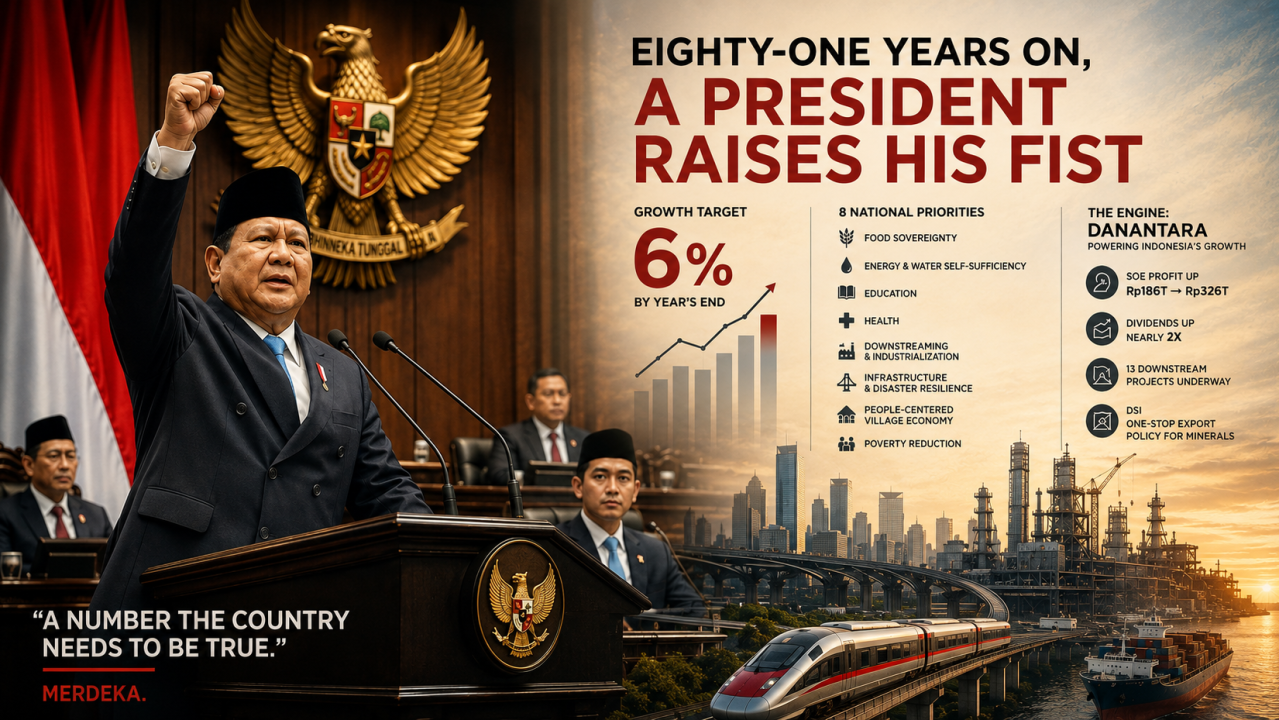
Prabowo Subianto stands before the MPR for the second time as president. Fist raised. Voice fiery. Eighty-one years since Sukarno’s proclamation, and the country is being asked, again, to believe in a number.
Six percent.
That’s the growth target he named – by year’s end, he said, if the world cooperates and the policies hold. The numbers behind him were real enough: 5.61% in the first quarter, 5.45% across the first half, the strongest opening to a year in 13 years.
He called it proof. Proof that the model works. Proof that state-driven growth, food self-sufficiency, downstreaming, the whole architecture of his first ten months, is bearing fruit rather than draining the treasury.
I’ve read a lot of these speeches over three decades here. They tend to follow a shape. Claim the wins. Name the enemies. Promise discipline. This one followed the shape – but the specifics matter, and some of them are worth sitting with.
What he claimed:
– The highest first-half growth in thirteen years
– A budget deficit narrowing toward 2.48% of GDP, with a balanced budget promised by 2027 or 2028
– Eight national priorities for the 2027 budget: food sovereignty, energy and water self-sufficiency, education, health, downstreaming and industrialization, infrastructure and disaster resilience, a people-centered village economy, poverty reduction
– Free nutritious meals, he said, no longer merely a plan on paper
What he threatened:
– Bureaucrats
– State-owned enterprises
– Police
– The military itself
Not the usual targets for a sitting president to name from that podium. Prabowo did it anyway, lashing out at waste and corruption inside the very institutions that carried him to power.
It’s the kind of move that either signals genuine resolve or theatre calibrated for an audience that’s stopped believing the theatre. Investors, watching from Singapore and beyond, aren’t fully sure which.
The engine he pointed to:
If there was one thread Prabowo returned to as proof of concept, it was Danantara – the sovereign wealth fund born out of the old SOE ministry, now running the state’s commercial muscle.
The numbers he cited were not modest. Total SOE profit climbing from Rp186 trillion to Rp326 trillion. Dividends nearly doubling. Semen Indonesia up over 400%. Pupuk Indonesia up 252%. Pertamina up 86%. Garuda pulling twenty grounded aircraft back into service, its fleet now at 104 planes.
Numbers like these don’t happen by accident, and they don’t happen by magic either – someone restructured something, somewhere, to make Pelindo post a 60% gain.
And the money isn’t just sitting in a ledger. 13 downstream projects broke ground in February – coal-to-DME, copper and gold smelting, industrial salt, alumina refining, waste-to-energy – with 13 more in April.
SOE profits, he said, are now financing the next wave directly. In May, Danantara spun up a new subsidiary, DSI, to run a one-stop export policy for the minerals Indonesia no longer wants to ship out raw nor experience the underreporting that has been going on for decades.
This is the part of the speech that matters most for anyone allocating capital here. Danantara is no longer a February 2025 press release and a Davos soundbite.
It is becoming the actual mechanism – the treasury, the industrial financier, the export gatekeeper – through which Prabowo intends to run the state’s economic hand.
Whether that reads as Temasek-style discipline or as a very large lever concentrated in very few hands depends, I think, on who you ask and how closely you’re watching the governance, not just the growth chart.
Here is the part the speech didn’t dwell on, but the room understood.
10 months ago, Prabowo’s approval sat above 80%. Today it’s roughly 51%. That is not a rounding error – it is a country recalibrating its faith in real time, as the cost of living presses harder than the growth chart suggests it should.
A president can stand at a podium and cite the best first-half numbers in over a decade. He cannot, by citing them, make a family in Surabaya feel the difference in their weekly shop.
That gap – between the macro story and the lived one – is the real story of this address. Not the 6%. Not the eight priorities. The gap.
For those of us doing business here – building joint ventures, advising foreign capital, watching the regulatory weather for signs of which way it’s blowing – the anti-corruption language deserves particular attention.
A president who publicly threatens the police and the military over graft is either building the foundation for a more predictable, rules-based Indonesia, or he is staging a performance that changes nothing on the ground. Both readings are plausible. Both have been true of past administrations, in different measures, at different times.
I don’t think we know yet which this is. I think we’re watching it get decided, month by month, procurement by procurement, appointment by appointment – starting, perhaps, with who gets named the next Bank Indonesia governor (who in todays news is positive), and how cleanly that process runs.
Danantara’s own trajectory will tell part of that story too – whether it grows into a disciplined, Temasek-style allocator of capital, or into something closer to a single lever for a single hand.
81 years of independence. A fist in the air. A number – six percent – that the country needs to be true.
We’ll know more by the time the budget clears parliament than we know today. I’ll be watching the fine print, not the fist.
Merdeka.