Bali is at a crossroads again. This time it’s not about beaches, or traffic, or the price of a coconut in Canggu.
It’s about who gets to invest here, and how.
The Part We All Agree On
Let’s start where there is no argument.
Foreigners abusing the system. Investors hiding behind a PMA to get a visa, and nothing more.
A rental scooter business registered as something else entirely.
A beauty salon that should have stayed in Balinese hands.
None of us defend this. Not the good operators, not the honest investors, not the people who came here and built something real.
If the goal was simply to close these loopholes – motorbike rentals, small retail, salons, the small-scale SME categories that were never meant for foreign capital – we would be writing a very different piece today. A short one. One that says: about time.
But that is not quite what is happening.
Where It Gets Complicated
Real estate. Hospitality. The categories that built modern Bali. These are the ones that deserve a harder look before anyone reaches for the KBLI eraser.
Because here is the uncomfortable question underneath all of this: Is over-development the fault of the investment structure – or the fault of everyone who was supposed to control it and didn’t?
Zoning that was never enforced.
Building permits handed out without oversight.
Compliance that existed on paper and nowhere else.
None of that is a KBLI problem. That is a governance problem. And closing the door on PMA structures does not fix a door that was never properly guarded in the first place.
We wrote about this before – about measuring the wrong market, mistaking visibility for volume. Some of that thinking holds here too. But there is more to unpack now.
The Repeat Guest Question
A large share of Bali’s arrivals are not first-timers.
They are people who came once, fell in love, and came back. Then came back again. Some of them wanted to invest – in a villa, a small resort, a wellness business — not to extract from Bali, but to stay connected to it.
If PMA is no longer the path, what happens to them? Do they simply move to private leasehold instead?
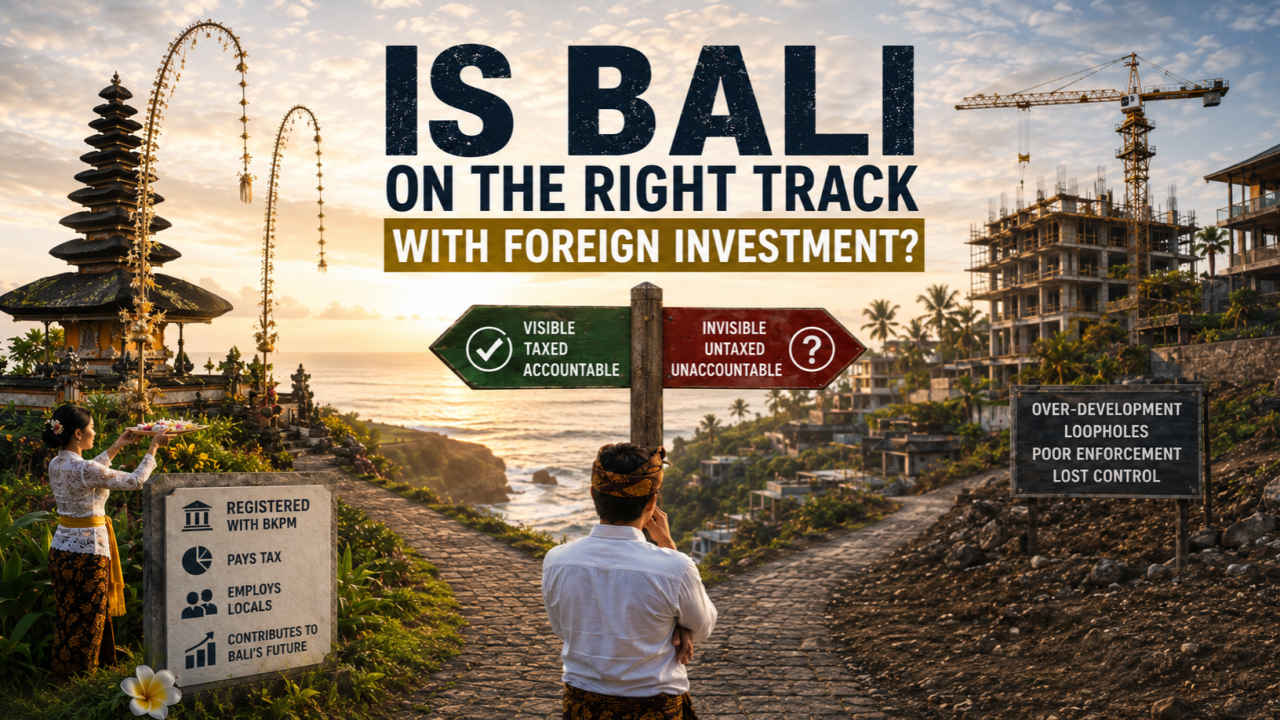
And if they do – haven’t we lost the one thing this policy was supposed to protect? The visibility. The tax base. The ability to actually see who is investing, how much, and where.
A PMA is traceable. It sits inside BKPM. It reports. Immigration and BKPM already cooperate to identify the bad actors – the system, when used, works.
A private lease agreement between a foreigner and a landowner reports to no one. So which one actually loses Bali more control?
The Digital Nomad Contradiction
Here is a question worth sitting with.
A foreigner can live in Bali today on a Digital Nomad visa. Work remotely. Earn elsewhere. Spend here. Contribute close to nothing in local tax, and remain almost invisible to the system.
That same person, wanting instead to open a PMA – pay corporate tax, employ Balinese staff, register capital, sit inside a regulated structure – may now find that door closing. What is the logic in that?
We are not being asked to choose between foreign investment and no foreign investment. We are choosing between visible, taxed, accountable investment — and invisible, untaxed, unaccountable presence.
That doesn’t sound like control. That sounds like losing it, quietly.
What the Market Actually Wants
Community-based resorts. Boutique villas. Wellness and functional medicine. Senior living. Long-stay lifestyle guests who come for months, not weeks.
This is where global tourism has been moving for years, and PMA has been part of how Bali met that demand.
If that door narrows, does the demand disappear? Or does it move – to Vietnam, to other parts of Indonesia, to wherever the next welcoming structure is?
Hotels will not miss this shift. Guests who never wanted a hotel in the first place will simply look elsewhere. Local investors with capital may not miss it either – fewer foreign competitors, more room to build.
But the common Balinese landowner leasing a small plot, the staff who would have been hired, the supplier who would have been paid — they are not the ones this protects. They are the ones left waiting for the dust to settle.
A Question of Scale
Before any of this goes further, someone should ask a simple question. What percentage of Bali’s foreign-owned businesses are actually the bad apples?
Is it a real, structural problem — or a loud, visible minority that went viral before anyone measured it. Because policy built on a viral moment and policy built on data rarely land the same way.
Family offices and Financial center. We all have seen the great news for this set up. But even these investors will want to lower their overall exposure, and reinvest by selling units to individual investors. If they cant will they then invest in the first place?
Where This Leaves Us
We are not against enforcement. We are not against protecting SME sectors from foreign encroachment. We agree with the intent.
But BKPM already has the tools to identify who has invested, who hasn’t, and who is abusing the system. That mechanism works when it’s used. The fix for bad actors is enforcement of what exists – not the dismantling of the structure that makes them visible in the first place.
Bali is competing in a tourism market that does not wait. Reputation, once shaken, is slow to rebuild.
This has the feel of a perfect storm – good intentions, real problems, and a policy response that may be reaching further than the problem itself.
Step carefully. The island can afford enforcement. It may not be able to afford the alternative.