Indonesia has never been shy about thinking big.
From downstreaming nickel and minerals to creating sovereign investment vehicles and pushing strategic industries, the country has been steadily moving toward a stronger and more coordinated economic model.
Some see this as intervention. Others see it as long-term nation building.
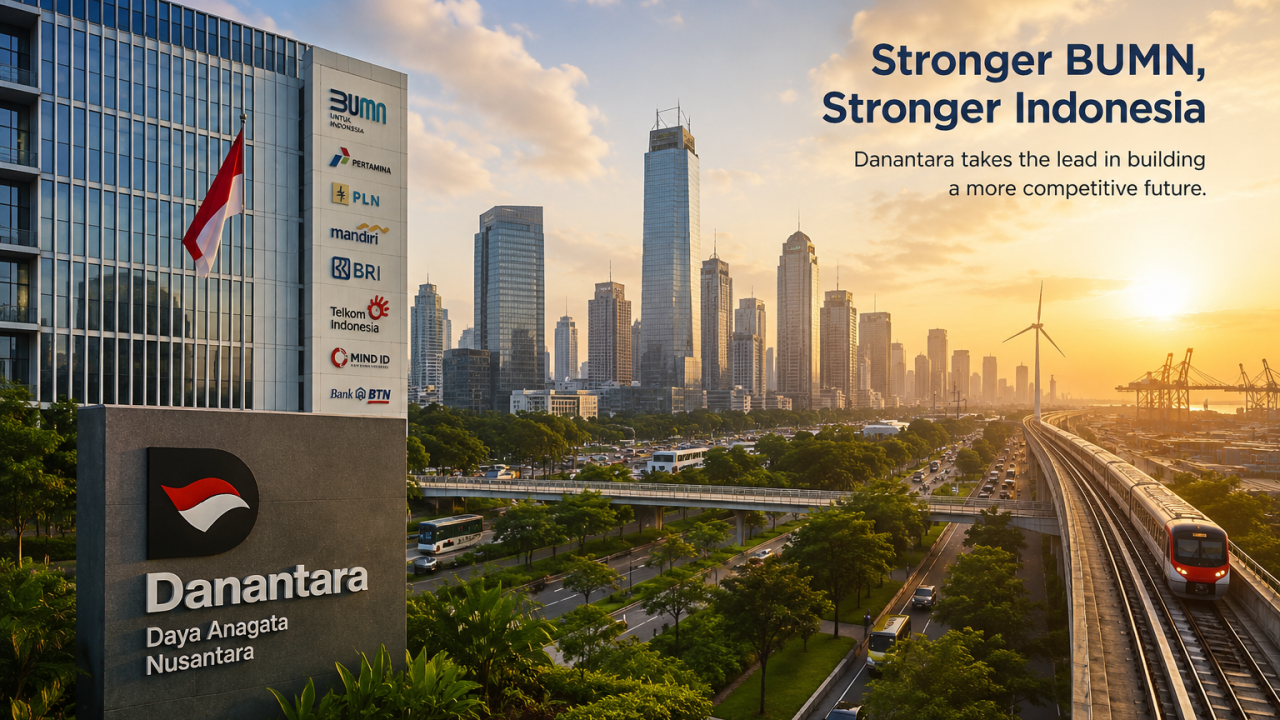
The latest move comes through Presidential Instruction No. 7 of 2026, which places Danantara and PT Danantara Asset Management at the center of an ambitious program to streamline State-Owned Enterprises (BUMN) and their subsidiaries.
At first glance, restructuring dozens of state companies may sound like dry bureaucracy. In reality, it could become one of the most significant economic reforms Indonesia has undertaken in years.
Less Quantity, More Quality
Indonesia has accumulated an enormous ecosystem of state-owned companies over decades. Some are highly strategic and profitable. Others overlap in function, operate inefficiently, or simply no longer fit the country’s future priorities.
The new directive aims to address that.
The objective isn’t privatization. Nor is it about reducing the state’s role. Rather, it seeks to create stronger, healthier, and more competitive state enterprises while preserving good governance and improving performance.
Danantara now assumes a central role, tasked with creating master plans, evaluating the effectiveness of existing entities, and coordinating restructuring efforts.
Whole-of-Government Approach
Perhaps what is most interesting is the degree of coordination involved. The Ministry of Finance is instructed to accelerate tax facilities and fiscal incentives.
BKPM and the Ministry of Investment are tasked with speeding up licensing and administrative processes through OSS while creating attractive investment schemes.
The Ministry of Law will accelerate legal approvals and supporting regulations.
The Ministry of Manpower is responsible for protecting workers and ensuring continuity of social security benefits.
Even governors, regents and mayors are instructed to support the process.
In many ways, this reflects Indonesia’s increasingly integrated approach to economic policy. Rather than ministries operating independently, the emphasis is on coordination and execution.
A More Competitive Indonesia
For investors and businesses, the significance extends beyond state companies.
When licensing processes are accelerated, tax incentives improved and legal approvals streamlined, the benefits often ripple outward into the wider economy.
Businesses that work with BUMN, supply BUMN, or invest alongside them may find new opportunities emerging through mergers, partnerships and restructuring initiatives.
Some sectors could witness consolidation. Others could attract strategic investors both domestic and foreign.
The message seems clear:
Indonesia wants its state enterprises to become stronger, not merely larger.
The Norwegian Parallel
Coming from Norway, I find the direction fascinating.
Norway also maintains a strong state presence in strategic sectors. State ownership itself is not unusual. The key lies in efficiency, governance and professional management.
Successful state participation requires institutions that can adapt and compete, not simply survive.
Indonesia appears to be moving toward that same philosophy—maintaining an active state role while simultaneously demanding performance and accountability.
Execution Will Be Everything
As with many reforms in Indonesia, implementation will matter far more than announcements.
Consolidation inevitably creates winners and losers. Mergers are complex. Organizational cultures differ. Employment concerns need to be handled carefully.
But if executed properly, this process could strengthen Indonesia’s industrial base and create more efficient national champions capable of competing regionally and globally.
And perhaps that is the larger story.
Indonesia isn’t stepping away from a state-driven development model.
It is refining it.
Danantara’s expanding role, together with coordinated reforms across ministries, signals that Indonesia is entering another chapter in its economic journey—one where efficiency, competitiveness and strategic national interests are expected to work hand in hand.
As always in Indonesia, the destination is ambitious.
And the journey itself will be fascinating to watch.