
For three years, Indonesia’s Personal Data Protection Law sat there like a promise half-kept.
Law No. 27 of 2022 gave the country its first comprehensive data protection statute. A milestone, everyone said. And it was.
But a law without implementing regulation is a house without doors – you can see the shape of it, admire the architecture, but you can’t actually live in it. Now the doors are in.
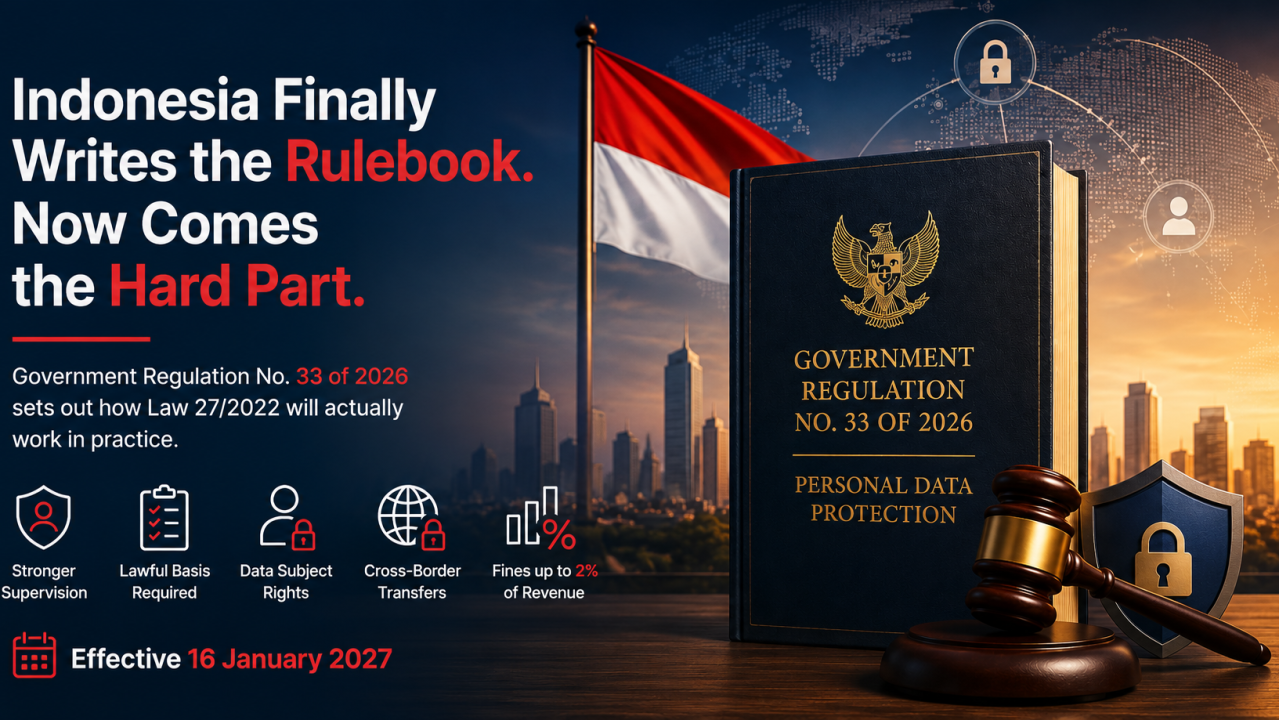
Government Regulation No. 33 of 2026 sets out how Law 27/2022 will actually work in practice – the mechanics, the deadlines, the teeth. It takes effect on 16 January 2027.
For anyone running a business that touches Indonesian personal data – which, in 2026, is nearly every business – this is the moment the abstraction becomes obligation.
What the regulation actually does
Strip away the legal density and Regulation 33/2026 does five things.
It creates an Institution with real supervisory power — monitoring, investigating, and sanctioning. It forces companies (Controllers, in the regulation’s language) to have a lawful basis for processing data before they touch it, not after.
It gives ordinary people rights they can actually exercise: to object to being profiled by an algorithm, to demand compensation when something goes wrong, to be told what happens to their data when a company merges or dissolves. It sets rules for sending data across borders. And it puts a number on the consequences of getting it wrong: fines up to 2% of annual revenue.
That last point deserves a pause. Two percent of revenue, not profit. For a company with thin margins and heavy turnover, that’s not a slap on the wrist.
The part most companies will underestimate
Everyone reads a new compliance regulation and thinks about the fine first. That’s the wrong order.
The regulation’s real weight sits in the internal governance requirements – the unglamorous, unphotographed obligations. Recording every processing activity.
Appointing a data protection officer for large-scale operations. Responding to a data subject’s request within 3 x 24 hours, not “as soon as reasonably practicable,” not “within a business quarter.” Three days. That’s the clock now.
Most companies I know in Indonesia – and I include plenty operating out of Bali – do not currently have systems that could meet that deadline. Not because they’re careless. Because until now, nobody made them build it.
Cross-border transfers: the quiet trapdoor
Here’s where it gets genuinely uncomfortable for a lot of operations.
If you’re sending Indonesian customer data to a server, a CRM, a marketing platform based outside Indonesia – and almost everyone is – the regulation requires the receiving country to offer protection equivalent to or higher than Indonesia’s own standard. If it doesn’t, you need binding safeguards in place, or the data subject’s explicit consent.
Most SaaS stacks weren’t built with this in mind. Most contracts with offshore vendors don’t currently address it. This is not a hypothetical compliance gap – it’s a live one, sitting inside ordinary business operations that nobody flagged as a data protection issue because it never felt like one.
What I keep coming back to
Regulations like this get written in the language of obligation and sanction, and that’s fair — that’s what they are. But underneath the legal architecture is a simpler idea: people should have some say over what happens to information about them.
Indonesia is not inventing this from scratch. It’s arriving, deliberately, at a framework that mirrors what the EU, and increasingly the rest of Southeast Asia, has already built. That’s not a criticism. Late and careful beats fast and hollow.
What matters now is whether the Institution has the capacity to actually supervise what it’s been given the power to supervise.
A law is only as real as its enforcement. Indonesia has plenty of well-written regulations that quietly went unenforced. This one comes with financial teeth attached – a number, a percentage, a deadline. That’s a different kind of signal than usual.
Sixteen months from passage to effect. Now the countdown to 16 January 2027 starts for real, and the companies that treat this as a checkbox exercise are going to find out, the expensive way, that it wasn’t one.