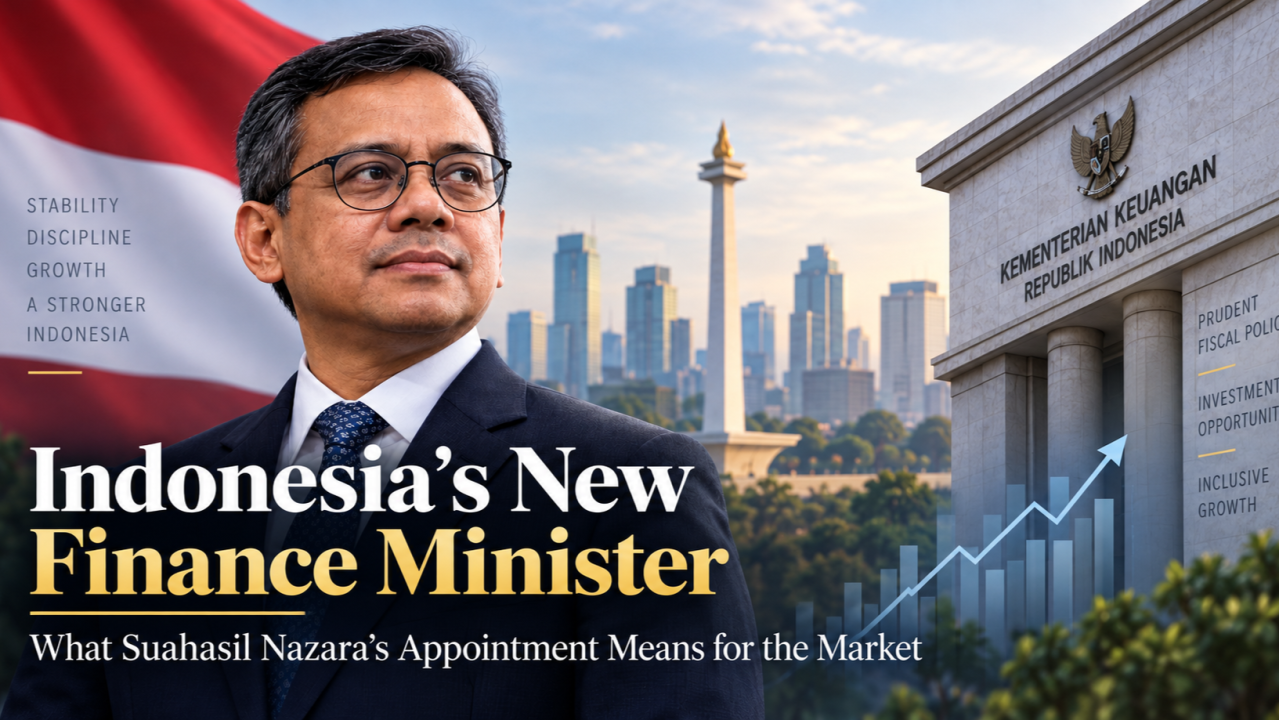
On September 14, President Prabowo Subianto swore in Suahasil Nazara as Indonesia’s new Minister of Finance, replacing Purbaya Yudhi Sadewa after just over a year in the post.
It’s the second finance ministry change in roughly twelve months – Purbaya himself only took over from Sri Mulyani Indrawati in September 2025 – and it comes at a moment when investors are watching Indonesia’s fiscal trajectory closely.
Here’s a breakdown of what’s changing, the arguments for and against the move, and what it could mean for markets.
The Background
Who is Suahasil Nazara? A 55-year-old economist, Suahasil is not a new face in Jakarta’s finance circles. He served as Deputy Finance Minister from 2019 onward, first under Sri Mulyani, then under Purbaya, and was reappointed to the deputy role in October 2024 under Prabowo’s cabinet. Before that, he headed the Fiscal Policy Agency (BKF) from 2016 to 2019.
What’s his mandate? Prabowo has directed him to “safeguard state finances” — maintaining fiscal health and credibility – while still enabling the government’s priority spending programs, including its ambitious 8% growth target by 2029.
Why did Purbaya go? The president’s office gave no official reason for the reshuffle, which has fueled speculation but no confirmed explanation.
The Case For (Pros)
▪️ Continuity and predictability. Suahasil has worked inside the finance ministry for close to a decade, across two previous ministers. Markets tend to reward familiar faces over unknowns, especially in a fiscal seat.
▪️ Investor familiarity. Analysts have described him as a “market-friendly veteran” – someone international investors already have a working relationship with, which can lower the risk premium attached to policy uncertainty.
▪️ Institutional credibility signal. Bank Danamon economist Irman Faiz framed the appointment as a signal of “continuity and institutional credibility” rather than a break from prior fiscal policy direction.
▪️ Technical competence. His background running the Fiscal Policy Agency suggests a steady, technocratic hand rather than a political appointment untested in fiscal management.
The Case Against (Cons)
▪️ Fiscal space is tightening. Suahasil inherits a mandate to fund Prabowo’s ambitious growth and spending agenda while keeping the deficit in check – a balancing act that gets harder, not easier, the longer it goes on.
▪️ Frequent turnover erodes confidence. Two finance minister changes within about a year is unusual for Indonesia and could itself become a source of unease, regardless of who fills the seat, if a pattern of short tenures continues.
▪️ Unclear rationale. The lack of an official explanation for Purbaya’s removal leaves room for speculation about internal disagreements on fiscal policy, spending priorities, or performance – none of which markets particularly like.
▪️ Deputy-to-minister transitions carry execution risk. Being a well-regarded deputy doesn’t guarantee the same effectiveness when accountable as the lead decision-maker, particularly under political pressure to deliver on growth targets.
What This Could Mean for the Market
The immediate market reaction offers a useful signal: Indonesian stocks largely erased a prior 2.6% loss following the announcement, and the 10-year government bond yield held steady at 7.17%.
That’s a market reading the change as reassuring rather than destabilizing – consistent with the “continuity” narrative rather than a “shake-up” one.
For those of us watching Indonesia from an investment and regulatory perspective, a few things are worth tracking over the coming months:
▪️ Bond yields and rupiah stability as early indicators of whether investor confidence in fiscal discipline holds.
▪️ Budget execution on Prabowo’s flagship programs – whether spending commitments stay within announced fiscal targets or start pushing the deficit wider.
▪️ Tenure itself. If Suahasil lasts well beyond a year, it may reinforce the credibility read. A third change within another twelve months would tell a very different story.
Where This Leaves Us
On balance, the appointment reads as a stabilizing move rather than a disruptive one – an insider brought in to reassure rather than reform. But “reassuring in week one” and “fiscally sustainable over the next three years” are different tests, and Indonesia’s growth ambitions leave little margin for slippage.
What’s your read – does installing a known insider like Suahasil actually buy Indonesia meaningful policy continuity, or does the frequency of these changes matter more than who’s sitting in the chair?