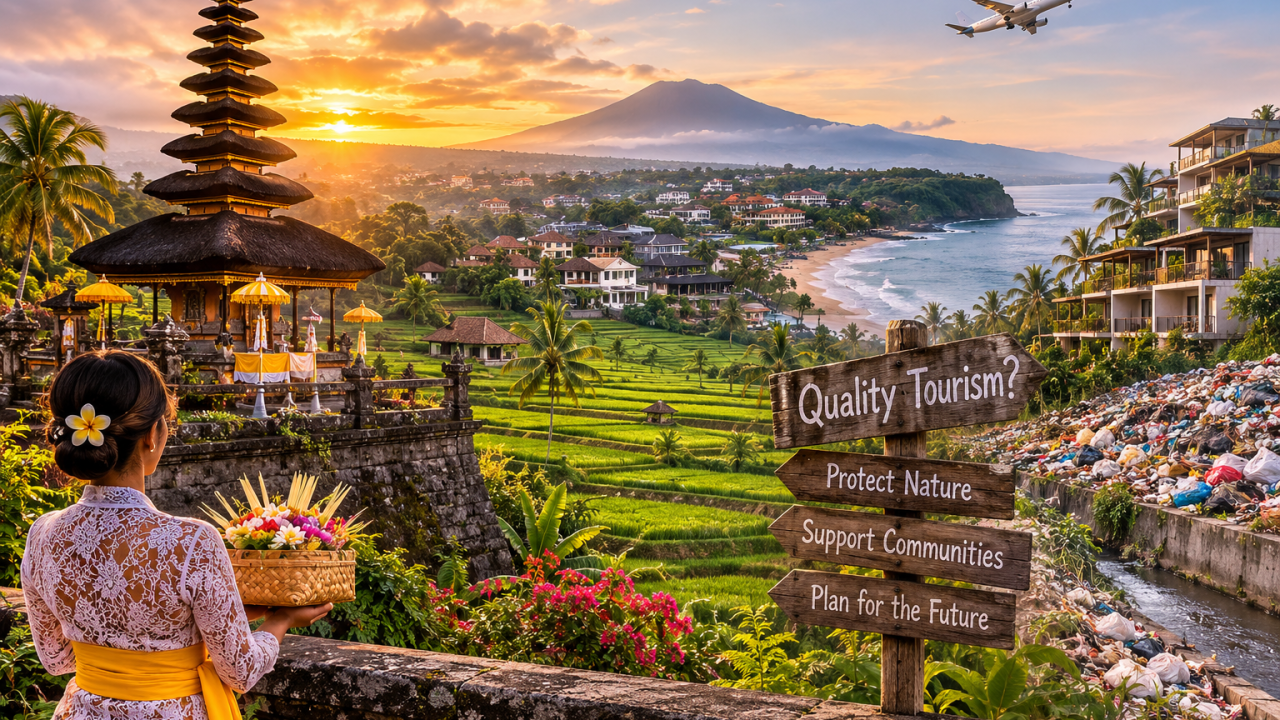
The next chapter of Bali’s tourism economy should be measured by what development contributes, not simply by how much gets built.
A property can make sense on a spreadsheet and still be wrong for its surroundings.
The projected rental income may look attractive. The purchase price may seem accessible. The design may photograph beautifully. But none of those things answers a more important question: can the neighbourhood support another accommodation business?
For Bali, that question belongs at the centre of the investment conversation.
The island’s post-pandemic transformation has brought new visitors, new businesses, and new ways to invest. It has also exposed the distance between selling a tourism property and building a destination that can sustain it.
The Investment Opportunity Beyond South Bali
Calls to spread investment beyond Bali’s busiest areas come with an important choice.
Tabanan, Buleleng, Karangasem, and Jembrana could develop tourism around their landscapes, agriculture, villages, and local character. Or they could absorb the same development pressures already familiar in the south.
Those are very different futures.
Simply moving construction to a quieter location does not create a better tourism model. Without planning, it can move the same problems elsewhere: development first, infrastructure later, and communities left to manage the gap.
A more thoughtful approach would establish the boundaries before inviting the investment.
Which agricultural areas should remain protected? Where can water supplies support additional accommodation? Which roads need improvement? What kind of tourism would residents actually welcome?
The opportunity is not to create another version of South Bali. It is to give each region room to develop on its own terms.
Smaller Properties Still Need Functioning Neighbourhoods
One of the most visible changes in Bali’s property market is the shift towards compact accommodation.
The traditional image of a spacious villa now sits alongside studios, loft-style rentals, co-living rooms, and smaller off-plan units marketed to buyers overseas.
The proposition is appealing: a lower entry price, a manageable property, and potential rental income.
For guests staying several weeks, a practical room with a desk and dependable internet may be more useful than a large villa with extensive services.
But the development calculation cannot end at the property boundary.
Several units on a single plot can mean more arrivals, deliveries, vehicles, wastewater, and rubbish. Whether the surrounding infrastructure can handle that activity matters just as much as the quality of the building itself.
The real measure of a project’s footprint is not its floor area alone. It is the demand it places on the place around it.
Quality Tourism Needs a Definition Investors Can Use
“Quality tourism” sounds like a shared ambition. Turning it into a useful development framework requires more detail.
Does quality mean higher-spending visitors? Longer stays? Better accommodation? Fewer environmental impacts? More income retained by local businesses?
These goals can overlap, but they are not interchangeable.
A costly holiday does not automatically support a healthier destination. Neither does an attractive resort automatically create meaningful benefits for its neighbours.
A clearer framework would assess tourism through questions such as:
▪️ Can local infrastructure support the proposed activity?
▪️ How much spending reaches local workers and businesses?
▪️ Is the accommodation registered, compliant, and safe?
▪️ Does the project protect the landscape and respect community life?
▪️ Are the rules clear and applied consistently?
These are questions that developers, operators, residents, and government can work with. They turn an abstract ambition into something that can influence real decisions.
Lifestyle Community Is Not the Same as Local Connection
Bali’s appeal now includes much more than a holiday itinerary.
Coworking spaces, wellness activities, sports clubs, and business gatherings offer newcomers an immediate social network. For many people, that sense of connection is a major reason to stay.
There is value in this. New communities can support entrepreneurship, friendships, and worthwhile collaborations. The challenge comes when those networks remain disconnected from the villages around them.
A residential neighbourhood should not have to become a nightlife district to accommodate a tourism business. Local culture should not be treated merely as scenery. And living comfortably among other newcomers should not be mistaken for understanding the place itself.
The stronger model is participation: businesses that listen to their neighbours, respect local arrangements, employ locally, and build relationships beyond their customer base.
Community should include the people who were already there.
Infrastructure Is Part of the Tourism Product
Roads, drainage, water, and waste services rarely lead a property sales presentation. Yet they shape the experience of everyone who lives in or visits a destination.
A well-designed room cannot compensate for an inaccessible road. A sustainability message means little without a workable waste system.
That makes infrastructure a tourism priority, not a separate administrative issue.
Before additional development is encouraged, Bali needs practical assessments of local carrying capacity: the level of activity an area can support without undermining its resources and everyday functioning.
Those assessments should inform development limits, infrastructure spending, and approval decisions.
They also require coordination. Transport routes, water systems, and waste flows do not follow regency boundaries neatly. Planning must connect across Bali rather than stop at each administrative border.
Better Rules Need the Resources to Deliver Them
It is easy to demand stronger enforcement. It is harder to provide the staffing, funding, technical support, and institutional coordination that make enforcement effective.
Bali’s local authorities operate within a wider system involving national investment policy, immigration, infrastructure funding, and business licensing.
Expecting local government to resolve every pressure on its own overlooks that complexity.
A more workable approach would combine clear local priorities with stronger national support, shared responsibilities, and public accountability.
Investors need that clarity too. Predictable requirements and consistent enforcement make it easier to distinguish a responsible project from one built around shortcuts.
Build for the Destination, Not Just the Booking
Bali does not have to choose between investment and protection. It does need to become more selective about the relationship between them.
Development can create jobs, improve services, and support local enterprise. But those benefits should be designed into a project, not assumed to follow automatically.
The next phase of Bali tourism should reward businesses that fit their surroundings, operate responsibly, and help preserve the reasons visitors come.
The question is no longer simply, “Will this property attract guests?”
It is, “Will this project help make Bali a better place to live in and visit?”
What would you prioritise for Bali’s next chapter: infrastructure, stronger development limits, local business opportunities, or protection of agricultural and cultural landscapes? Share your perspective in the comments.