Every country has a vision. Walk into the planning ministries of almost any developing nation, and you will find ambitious blueprints and glossies detailing a prosperous future.
Yet, history tells us that some countries write brilliant plans that never leave the pages of government reports, while others quietly turn those long-term goals into roads, factories, schools, ports, and tangible opportunities. Indonesia’s Vision 2045 is undeniably one of the most ambitious national development plans in the world today.
Aiming for fruition by the centenary of its independence, the roadmap outlines a massive transformation: elevating Indonesia into a high-income nation, creating a modern industrial economy, strengthening food and energy security, and building critical infrastructure across a sprawling archipelago of over 17,000 islands.
It is a monumental task to improve the quality of life for more than 280 million people. But having spent more than three decades living and working in this country, I sense a profound shift in the conversation.
Indonesia no longer lacks ambition or direction; the grand vision has been established. The real question now is execution.
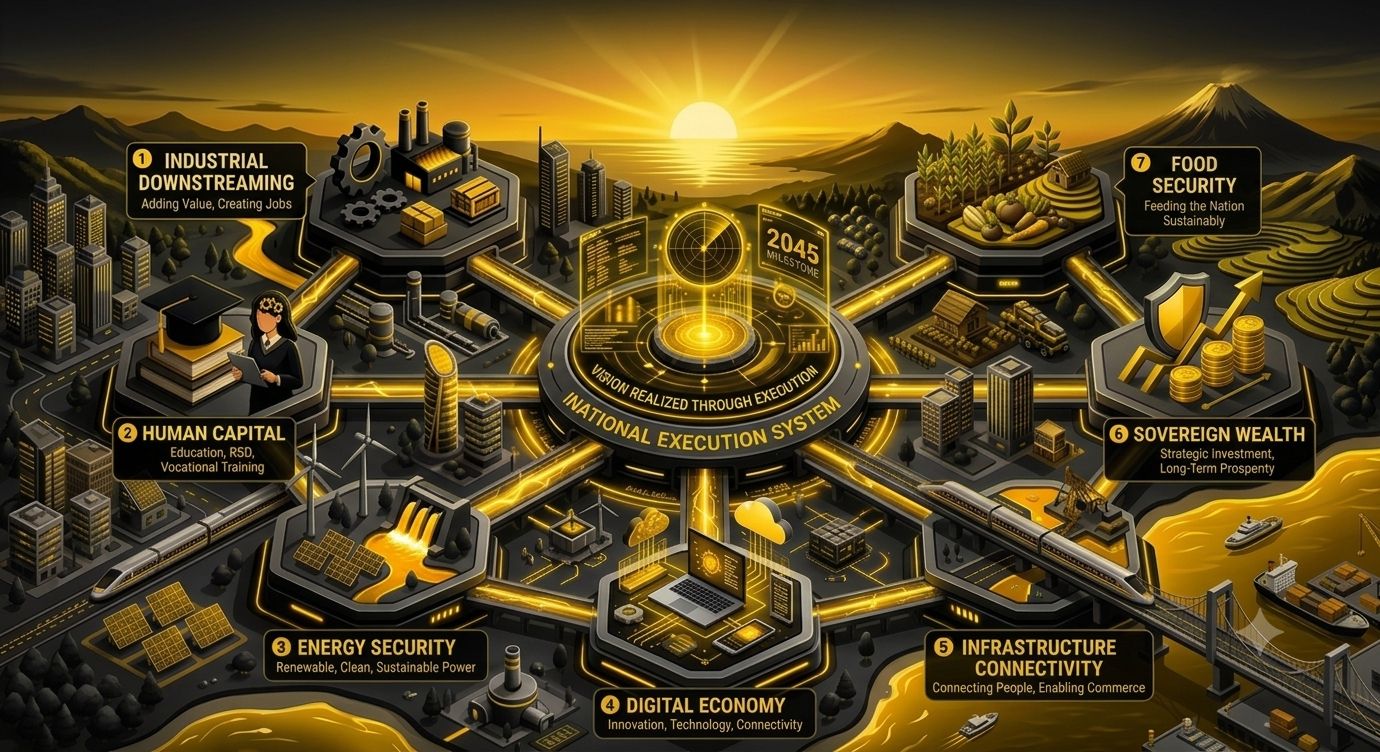
From Exporting Resources to Creating Value
For decades, Indonesia’s economic playbook was simple and predictable: extract natural wealth and export it in its rawest form.
Millions of tons of nickel, copper, bauxite, coal, and palm oil left Indonesian shores, fueling industries abroad while leaving the domestic economy vulnerable to the volatile whims of global commodity cycles.
Increasingly, however, government policy has pivoted toward aggressive downstream industrialization – mandating that resources be processed domestically before they ever reach global markets.
The objective behind this downstream processing (hilirisasi) is straightforward: move up the global value chain to create sustainable jobs, develop cutting-edge domestic industries, build technological capability, and retain the economic value within the country.
Whether we look at the rapid integration into electric vehicle (EV) supply chains, battery manufacturing, or advanced metal processing, the long-term trajectory is clear. Indonesia is no longer content to just export raw commodities. It wants to export sophisticated value.
Food Security Is National Security
While industrialization grabs the headlines, one of the quieter yet most critical pillars of Indonesia’s future is food. A nation of this scale cannot afford to rely excessively on fragile global supply chains.
Recent history – marked by climate volatility, geopolitical tensions, and protectionist trade shifts – has served as a stark reminder to governments worldwide that food security is fundamentally tied to economic and national security.
This is why systemic investments in agriculture, smart irrigation, cold-chain logistics, and modern farming methods are vital.
They may never attract the same international spotlight as high-tech startups or luxury tourism, but they will shape Indonesia’s resilience for decades to come.
For provinces like Bali, this focus presents a unique opportunity to recalibrate. Rather than allowing tourism to cannibalize and replace agriculture, there is a growing realization that the two sectors must interconnect – where local sustainable farming directly feeds and enhances the premium hospitality ecosystem.
Energy Independence and the Digital State
Parallel to food security is the inescapable challenge of the energy transition. Indonesia is blessed with vast renewable potential, from geothermal resources and hydropower to solar and cleaner industrial development.
These resources are becoming central to the country’s long-term strategy. However, the state also recognizes that energy security requires absolute reliability; sustainability cannot come at the cost of blackouts or stunted industrial growth.
Balancing rapid economic expansion with environmental responsibility will remain one of the defining tightropes of the next twenty years.
Concurrently, a quiet bureaucratic revolution is happening inside the government apparatus itself. Crucial processes that used to take weeks of paperwork – licensing, tax administration, business registration, and basic public services – are steadily becoming digital, integrated, and data-driven.
While no digital ecosystem is flawless, the direction is unmistakable. A capable digital state reduces friction, curbs corruption, and builds immense confidence for both local entrepreneurs and international investors.
Good governance is no longer just about drafting sophisticated regulations; it is about implementing them seamlessly.
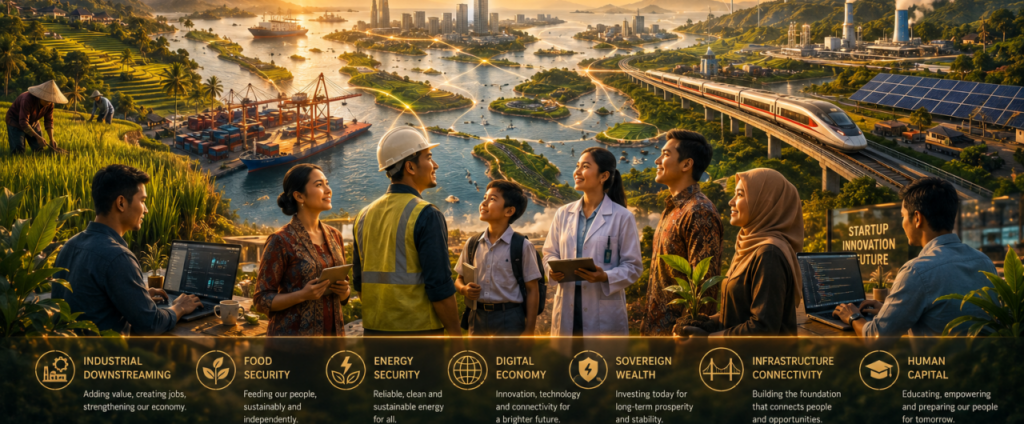
Infrastructure and the True Value of Human Capital
Indonesias infrastructure boom is often measured mathematically in kilometers of toll roads, the capacity of new deep-water ports, or the slick design of modern airport terminals. But infrastructure is ultimately about something much bigger than concrete and steel: it is about creating opportunity.
Every new road connects an isolated farmer to a vibrant municipal market. Every optimized port slashes prohibitive logistics costs.
Every reliable airport breathes life into regional tourism, and every stable digital connection allows a small home business to scale nationally. Infrastructure does not simply move people; it moves entire economies.
Yet, the most critical investment Indonesia must make is one that cannot easily be photographed for a press release: human capital. This means education, healthcare, vocational training, and R & D.
Indonesia’s famous demographic dividend—its young, vibrant population – will only become an economic asset if tomorrows workforce possesses the skills required by tomorrows high-value industries.
Factories can be built in a matter of months and technology can be imported with capital, but indigenous talent must be meticulously developed over generations.
The Role of Sovereign Wealth and the View from Bali
To finance this massive leap, Indonesia has moved away from relying solely on traditional debt or annual budgets, taking significant steps to mobilize long-term global capital through its sovereign wealth initiatives and state investment institutions.
Their role is not merely to bankroll projects, but to crowd in private investment, de-risk mega-projects, and strategically back sectors vital to long-term competitiveness. For international investors, this signals a refreshing maturation: Indonesia is increasingly planning in decades, rather than five-year election cycles.
Living and working in Bali, it is dangerously easy to view Indonesias economic narrative through the singular lens of leisure and tourism. But Bali’s future is deeply intertwined with the broader macroeconomic choices being made across the archipelago.
A stronger domestic manufacturing and tech sector creates higher incomes nationwide, which in turn expands the Indonesian middle class. A larger, wealthier domestic middle class travels more, spends more, and invests back into the regions.
Better national infrastructure improves Balis connectivity, and stronger education systems produce the creative entrepreneurs and tech talent that Bali’s shifting economy needs. Tourism flourishes best when the broader economy surrounding it is robust and diversified. Bali is not an isolated paradise; it is a vital organ in a larger organism.
Delivery Is the Ultimate Test
No national development plan unfolds precisely as it is written on paper. There will be global recessions, geopolitical curveballs, domestic policy pivots, and inevitable setbacks.
That is the reality for any nation attempting a historic economic leap. What matters most is not whether every single metric is hit perfectly on schedule, but whether the overarching direction remains fiercely consistent.
The debate in Indonesia has successfully shifted from whether the country should modernize to how it can execute that modernization more effectively. This is a sign of a healthy, maturing economy.
Indonesia’s greatest challenge today is no longer imagining a better future; it is the daily, gritty work of delivering one. If execution continues to match ambition, Indonesia’s Vision 2045 will be much more than an aspiration. It will stand as one of the most remarkable economic transformations of the twenty-first century.