An Indonesia tax holiday lasting up to 50 years is the kind of announcement that makes business owners stop scrolling. Half a century without corporate income tax? That deserves a closer look.
The offer sits within Indonesia’s new International Financial Center framework, known locally as Pusat Finansial Internasional Indonesia, or PFII.
Law No. 6 of 2026 took effect on 19 August 2026, creating the legal foundation for a dedicated financial ecosystem with its own institutions, licensing arrangements, and tax facilities.
But this is not a nationwide tax break for every foreign-owned company. Who qualifies, which income receives relief, and how the rules work in practice matter just as much as the headline.
Indonesia Tax Holiday: What Is the PFII?
Indonesia wants to attract more financial businesses, investment managers, family offices, and the professionals who support them. The PFII is its proposed platform for bringing those activities into a dedicated financial centre.
The framework covers a wide range of activities, including:
▪️ Banking, insurance, and capital markets.
▪️ Financial technology and investment management.
▪️ Family offices, trusts, and treasury activities.
▪️ Supporting legal, accounting, tax, and advisory services.
The law also provides for dedicated management and supervisory bodies, arbitration, and a specialised court. In short, this is more than a tax discount, it is an attempt to build a financial ecosystem with its own operating framework.
Eligible Businesses and Qualifying Income for Indonesia Tax Holiday
The main attraction is a 100% corporate income tax reduction for qualifying PFII activities. Certain core financial activities may receive the facility for up to 50 years, while other eligible activities have different periods and conditions.
That distinction matters:
▪️ Financial businesses must meet the requirements for the qualifying activity.
▪️ Supporting and other businesses should not assume they receive the same 50-year period.
▪️ Income outside the qualifying PFII activity does not automatically receive the benefit.
A company cannot simply register a PFII presence and assume its entire business becomes tax-free. It will need to identify which activities and income qualify, then keep the supporting records clear.
Indonesia Tax Holiday: Does Zero Tax Really Mean Zero?
For some large multinational groups, not necessarily.
The PFII framework recognises international tax commitments, including the Global Minimum Tax rules. These can reduce the practical value of a local tax holiday for businesses within their scope.
Put simply, a company might receive a tax reduction in Indonesia but still face additional tax under the applicable minimum-tax rules. A lower bill in one place does not always mean a lower bill overall.
This makes the calculation different for different businesses:
▪️ Large multinational groups need to model the incentive alongside their international minimum-tax exposure.
▪️ Groups outside those rules may obtain a different effective benefit.
▪️ Every applicant still needs to check eligibility, qualifying income, and the final implementing rules.
The useful question is not just “What rate does Indonesia offer?” It is “What will the group actually pay after all applicable rules are considered?”
Indonesia Tax Holiday: What About Family Offices and Foreign Residents?
The PFII law also looks beyond companies. Family offices, organisations that manage a family’s wealth and related affairs, are expressly included in the framework.
For qualifying foreign nationals, the potential facilities include:
▪️ Special tax-residence treatment linked to PFII family office registration and a PFII Golden Visa.
▪️ Specific inheritance-tax treatment where the required registration conditions are met.
▪️ Tax facilities for qualifying investment income received by non-resident taxpayers.
▪️ Preferential treatment for eligible financial-sector experts and certain foreign-source income.
These are conditional benefits, not a general exemption for everyone holding a long-stay visa.
For example, the special residence treatment requires qualifying family office registration, a PFII Golden Visa, and no active business or employment income from a PFII or other Indonesian business.
That last condition is important. Someone actively running or working in an Indonesian business should not assume the PFII automatically removes their Indonesian tax obligations.
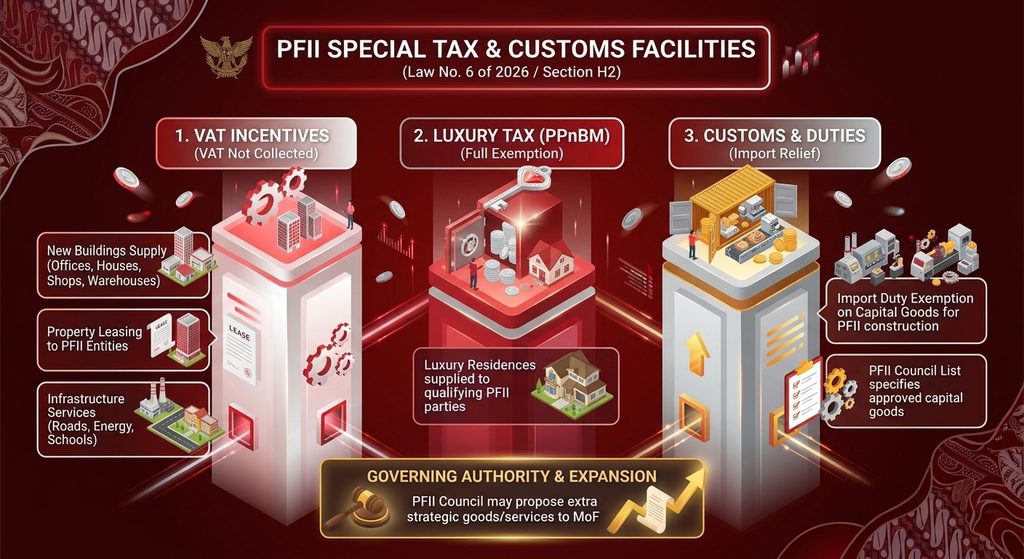
Indonesia Tax Holiday: Extra Relief for Property and Imports
Building a financial centre requires more than attracting banks and wealthy families. It also needs offices, infrastructure, services, and supporting facilities.
The law therefore provides a basis for:
▪️ VAT not being collected on qualifying goods, services, and property transactions.
▪️ Luxury-goods sales tax exemptions for qualifying transactions.
▪️ Customs facilities for eligible imports connected with PFII development.
However, these facilities have their own requirements. A property purchase, construction contract, or import shipment does not qualify simply because the buyer has heard about the PFII. The transaction and recipient must fit the applicable rules.
Ongoing Duties and Reporting after the Tax Holiday
A tax incentive can reduce the amount payable. It does not remove the responsibility to maintain proper records.
Eligible recipients must still meet requirements covering:
▪️ Tax identification and registration.
▪️ Bookkeeping and supporting documents.
▪️ Tax withholding and collection where applicable.
▪️ Tax returns and reports on facility use.
Incorrectly claimed facilities may be withdrawn and recovered, with applicable sanctions. Anti-money-laundering, beneficial-ownership transparency, and tax-information requirements also continue to apply.
Indonesia Tax Holiday: What Should Businesses Do Next?
The opportunity is significant, but the practical details will decide how useful it becomes.
The law requires implementing regulations within six months of promulgation, with further rules covering matters such as locations, licensing, eligibility, incentive periods, and institutional procedures.
Before committing to a structure, businesses should assess:
▪️ Whether their planned activities fall within the PFII framework.
▪️ Which income could qualify for relief.
▪️ Whether international minimum-tax rules affect the benefit.
▪️ What licensing, registration, and operating requirements apply.
▪️ Which details still depend on further regulations.
The sensible approach is to assess the opportunity now, without treating every headline benefit as an immediately available entitlement.
Seven Stones Indonesia can help foreign businesses and individuals review how the developing PFII framework may fit their wider plans in Indonesia.
From company structure and business licensing to tax coordination and ongoing compliance, the starting point is understanding the business, not simply chasing the lowest advertised rate.
Contact Seven Stones Indonesia to discuss the proposed structure, identify the questions that need answering, and prepare for the rules that will shape the PFII in practice.
This article provides general information, not legal or tax advice. PFII eligibility, incentives, and operating requirements remain subject to the applicable law and implementing regulations. Check the current rules before making investment or tax-planning decisions.