There is a moment, early in every foreigner’s Bali property search, when someone leans across a table and says: “Just take the lease. It’s easier.”
It usually is.
And that single piece of advice—repeated in villa lobbies, in agent WhatsApp groups, and in the comment sections of expat Facebook pages—is, I think, where it all went wrong.
Not wrong because leasehold is illegal. It isn’t.
Wrong because it became the default. The path of least resistance became the path with the least protection. And nobody stopped to ask why the easy road was also the weakest one.
Three Doors, One Word for All of Them
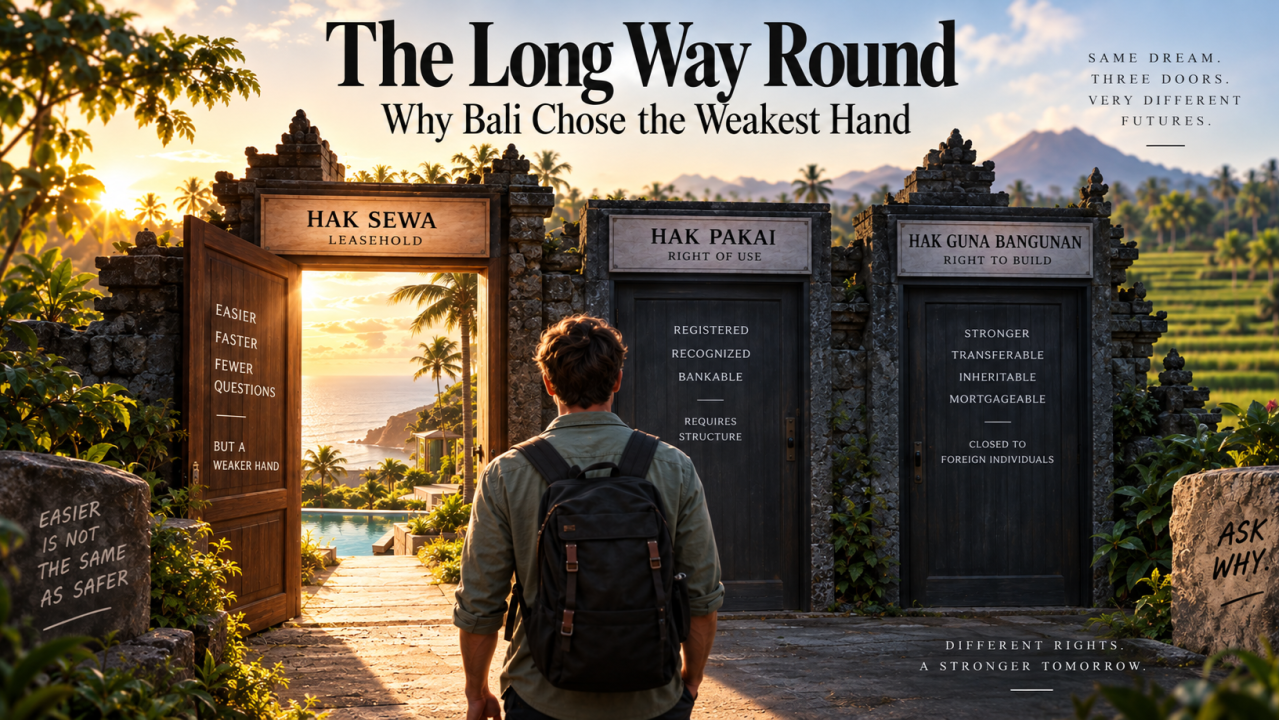
Foreign buyers in Bali talk about “buying property” as if it were a single, simple transaction. It isn’t. There are at least three distinct doors into Indonesian land, and they lead to very different rooms.
▪️ Hak Sewa (Leasehold): A standard lease. A contract between two private parties. The owner keeps the official title. You keep a piece of paper and a promise.
▪️ Hak Pakai (Right of Use): A recognized land right granted over property held by someone else. Unlike a lease, it is recognized under Indonesia’s Basic Agrarian Law as an actual legal right to the land, not just a personal deal. It is officially registered with the government. In its time-bound form, it can even be used as collateral for bank loans. It sits in the national land registry, not just in a private filing cabinet.
▪️ Hak Guna Bangunan (HGB / Right to Build): The right to build and own a structure on land held by someone else. It is even stronger—transferable, inheritable, and mortgageable. However, it is closed to individual foreigners. It is reserved for Indonesian citizens and companies set up in Indonesia.
Three doors. Only one of them—the weakest one—was ever really open to a foreigner acting alone. The other two required a proper setup: a foreign company (PT PMA), or a process with more steps and closer check-ups.
So almost everyone took the open door.
Easier Is Not the Same as Safer
Here is the part nobody explains over coffee.
A lease is just a contract. Its strength depends entirely on the paper it is written on and the goodwill of the owner. It is not, in the strict sense, an officially registered right to the land itself.
It does not carry the same weight as Hak Pakai when you ask a bank for a loan, and it has nowhere near the legal standing of HGB when building ownership is questioned.
Hak Pakai and HGB, by contrast, are full legal land rights. They are officially registered, certified, and bankable under the right setup.
And yet—almost everyone who came to Bali to build a life, a villa, or a small business signed a private lease. Not because it was the safer option.
Because it was the option that didn’t ask questions. No foreign company (PT PMA) to set up. No business activity codes to prove. No minimum investment capital required. No permit officer to convince that your gym, café, or rental villa deserved a foreign business license in the first place.
Leasehold asked for a signature and a bank transfer. Hak Pakai and HGB asked for a company, a clear structure, a foreign investment plan, patience—and a local government willing to approve that setup.
The Hidden Costs of the Easy Option
And then, after taking the easy path, foreign buyers discovered its other hidden costs.
Lease payments in Indonesia are taxed as income for the landlord—often at a fixed tax rate that, if calculated poorly, can eat heavily into what seemed like a straightforward deal.
When the lease ends, extension prices are renegotiated at the landlord’s discretion. Any rise in property value over 20 or 30 years goes to the land owner, not the tenant. None of this shows up in glossy sales flyers.
Meanwhile, a properly set-up Hak Pakai or HGB holding—though harder to set up and slower to get—carries far fewer of these hidden costs. It works like the real land right it actually is.
We built an entire market for foreign property buyers around the door that was wide open. Then, we were surprised to find out that the room on the other side was much smaller than promised.
Where the Numbers Stand
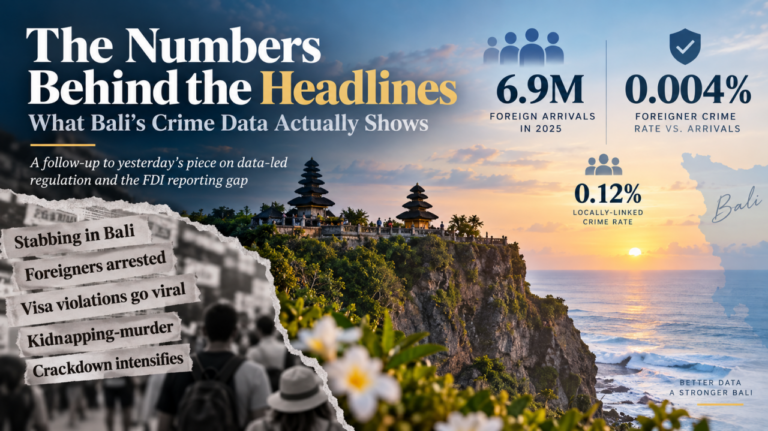
Estimates show that roughly 9 out of 10 foreign property deals in Bali are done through private lease contracts. These take place outside official government investment tracking systems.
This means the actual amount of foreign money invested in Bali’s property market is likely far larger than official numbers show. It also means that money is mostly unregistered, unprotected, and lacks the legal security that a Hak Pakai or HGB structure provides.
It also means that when local authorities step in—as they have started doing recently by closing down certain business licenses for foreigners rather than fixing the complicated land rights system—they are closing the wrong door.
The issue was never that foreigners wanted to invest in Bali. The issue is that the easiest path was also the weakest one, and an entire market built its foundation there without realizing it.
If you are standing at that table now, being told to just take the lease – ask why. Ask what door it actually is, and why it was the one left open. The answer says less about you than about a system that made the strong rights hard to reach, and the weak one easy.