For decades, global wealth management centered on a few established financial hubs like Singapore, Hong Kong, Switzerland, and London. Indonesia rarely entered those discussions.
That dynamic is changing rapidly. Jakarta is not trying to replace Singapore as a hyper-liquid trading hub. Instead, Indonesian policymakers are actively courting a different class of investor—one that prioritizes multi-generational growth over quarterly profits.
The Shift Toward Patient Capital
Over the last decade, Indonesia altered its economic strategy. Rather than simply asking how to attract quick foreign capital, leaders focus on attracting capital that builds long-term national wealth.
This philosophy drives major policy initiatives:
- Mineral Downstreaming: Processing raw resources locally to create high-value industrial exports.
- Infrastructure Expansion: Building modern transport and utility networks across major islands.
- Digital Economy Growth: Expanding digital payment systems and technology infrastructure.
- Energy Transition: Directing funds into renewable energy and green technology projects.
While institutional funds face strict exit deadlines, family offices excel at long-term investments.
They offer decadal horizons, low-leverage equity, and operational flexibility to invest directly in physical businesses. This approach matches the Golden Indonesia 2045 national growth strategy.
Strategic Synergy: Institutional Banks vs. Family Offices
Investment banks create market liquidity through quick transactions. Family offices build multi-generational relationships while offering expertise, international networks, and corporate governance:
| Feature | Traditional Investment Banks | Family Offices |
| Timeline | Focuses on shorter investment cycles. | Maintains multi-generational horizons. |
| Core Driver | Reacts to capital market fluctuations. | Focuses on real-world business growth. |
| Approach | Prioritizes transaction volume. | Prioritizes deep relationship building. |
| Leverage | Operates with higher leverage levels. | Uses patient, low-leverage equity. |
| Endgame | Directs focus toward short-term exits. | Focuses on long-term stewardship. |
A stewardship-focused investor builds sustainable domestic companies, supports local employment, and withstands changing economic cycles.
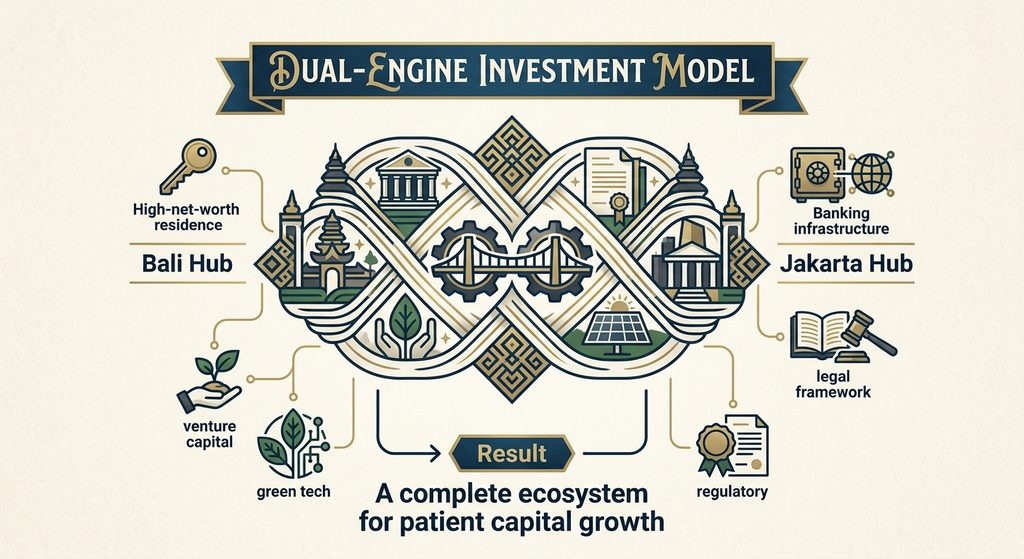
The Dual-Engine Model: Bali and Jakarta
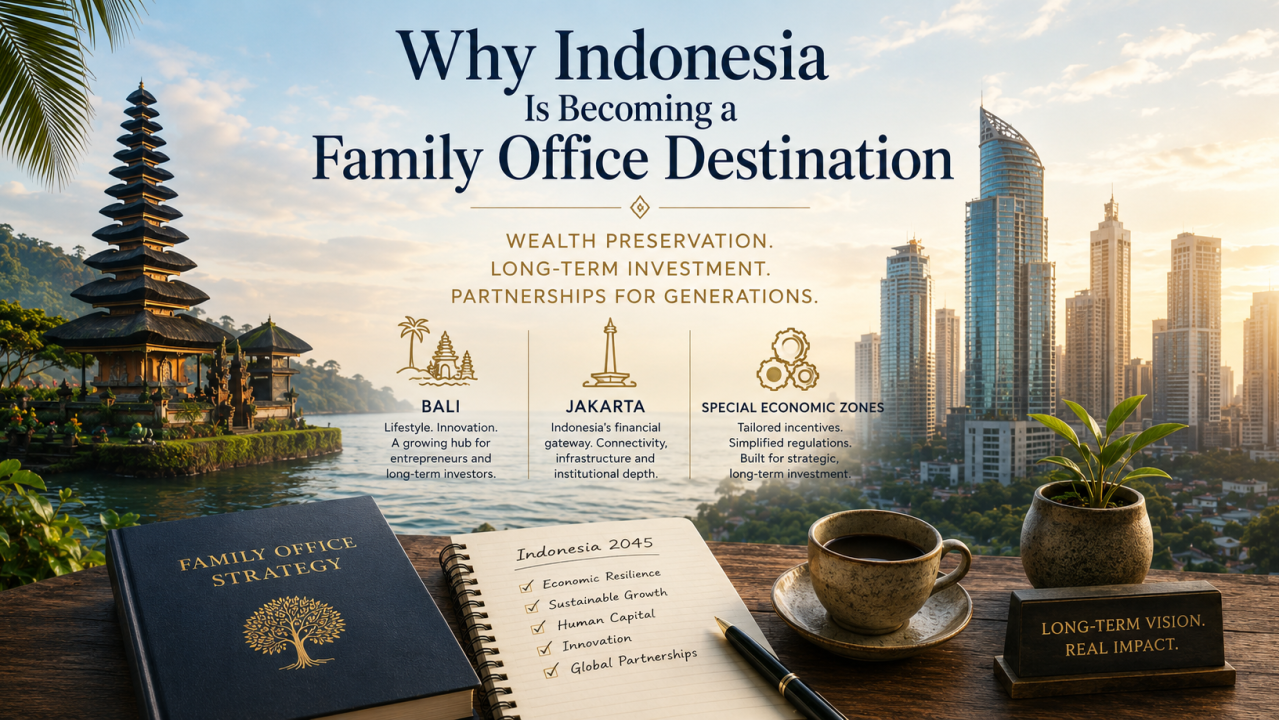
Indonesia combines lifestyle appeal with commercial infrastructure to attract international wealth creators:
- Bali (The Lifestyle Magnet): Attracts high-net-worth entrepreneurs, venture funds, and direct investment into hospitality, healthcare, education, and green technology.
- Jakarta (The Commercial Gateway): Provides regulatory access, corporate banking facilities, legal structures, and professional advisory services.
Special Economic Zones (SEZs)—such as Kura Kura Bali and the Sanur Health SEZ—offer targeted tax incentives and streamlined licensing to help family offices set up operational bases efficiently.
The Path Forward for Wealth Preservation
Sustaining this momentum requires consistent regulations, predictable tax frameworks, and clear dispute resolution processes. Omnibus law reforms have improved the business landscape, but policy stability remains essential for global investors.
Indonesia offers investors an alternative to volatile paper markets by providing direct access to a growing real economy. Investing directly in local industries, infrastructure, and human capital provides a reliable path toward long-term wealth preservation.