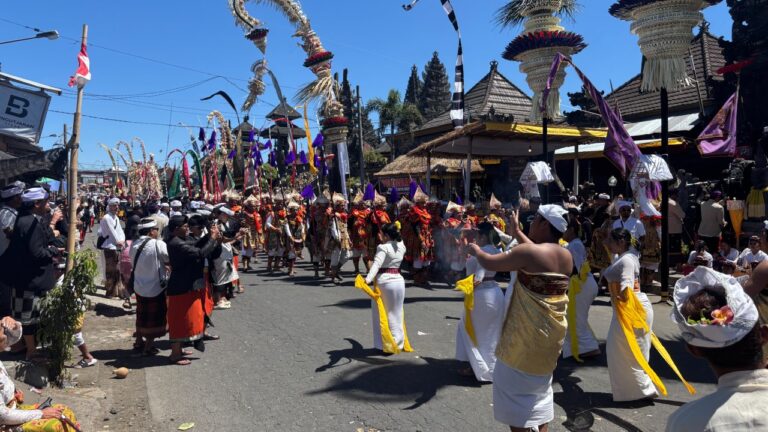
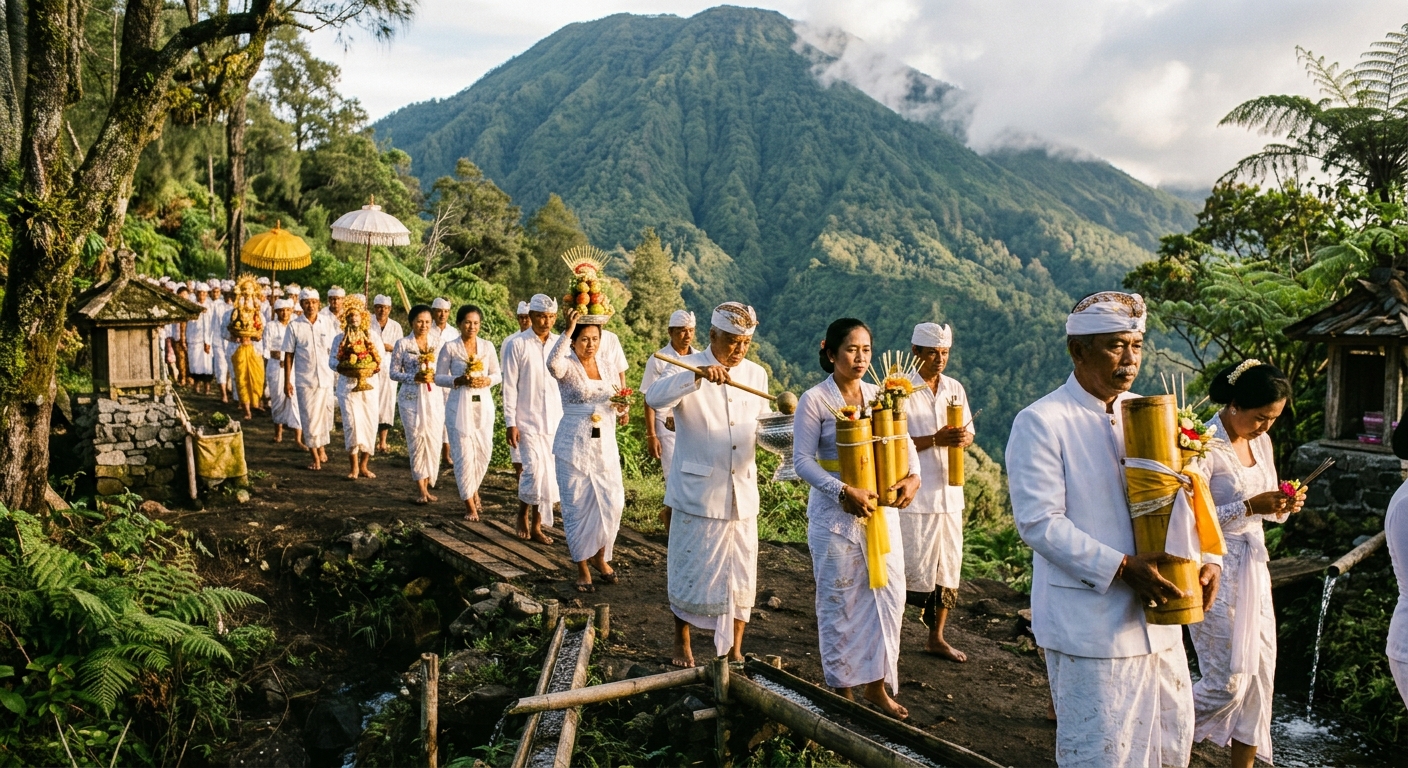
In our previous article about the upcoming ceremony of Madewasraya centred on Pura Tuluk Biyu in Kintamani, we introduced the idea that in Balinese philosophy time isn’t something that just passes in a linear sense. In this article, we’re going to try and expand on that.
If you’ve lived in Bali for long enough, you’ll know what we mean when we say that time itself has a persona. A wedding, for example, is planned for an auspicious day. Construction begins only after the appropriate date has been determined. Cremations, temple ceremonies, journeys and important undertakings are all aligned with calendars that appear, to the uninitiated, bafflingly complex.
But if we want to better understand Madewasraya, we need to go a little deeper, because it’s not just a ceremony waiting for a particular astrological alignment, like a celestial procession or a full moon. That would be too easy, and the ceremony’s ancient machinery is considerably more interesting and nuanced than that.
At its heart is a relationship between time, crisis, mountain, water, humanity and the wider universe, and an extraordinary ritual instruction whose origins can be traced back more than a thousand years. To better understand it, we need to climb Gunung Abang, and we need to follow the water down.
About the Calendars
There is a temptation when writing about Bali to describe everything unfamiliar as mystical. The Balinese calendar is complicated enough without adding unnecessary mystery; Bali actually operates with several concepts of time simultaneously.
Alongside the international Gregorian calendar is the Saka calendar and the extremely intricate Pawukon system.
The Pawukon consists of overlapping cycles that run concurrently and return to their starting configuration after 210 days. Some of these cycles contain five days, some six, some seven, with others operating alongside them. The result isn’t simply another method of counting days. It provides a way of identifying their qualities.
As scholars of the Balinese calendar have observed, its purpose is not merely to tell you what time it is, but what kind of time it is. And in Bali, that’s an important distinction.
It’s also where we need to draw our first line between general Balinese cosmology and Madewasraya itself.
The Pawukon and Saka calendars structure religious life throughout Bali. Auspicious timing, lunar phases, and calendrical conjunctions influence countless ceremonies. They are part of the cultural universe in which Madewasraya exists. But they are not, by themselves, an explanation for Madewasraya. To get to that, we need to look somewhere else.
Who Decides When the Time Is Right?
If the Pawukon and Saka calendars help determine the qualities of time, but don’t themselves explain why Madewasraya takes place, what does?
The answer appears to lie in a relationship the Balinese know as Desa, Kala, Patra: place, time and circumstance. And the three do not exist independently.
Desa asks where we are. Not simply in the geographical sense, but within a sacred landscape in which mountains, lakes, temples, water sources and communities have particular relationships with one another.
Kala asks whether the time is appropriate. Bali’s calendars help identify the character of that time, but the calendar is only one part of the equation.
And Patra asks what is actually happening.
This last part is crucial to understanding Madewasraya, because it isn’t just a full moon ceremony. When society is in crisis, Balinese cosmology argues the reasons causing the imbalance aren’t isolated, and neither is the response. Circumstance creates the need for a response.
Sacred time helps determine when that response can appropriately be made. Sacred geography determines where particular parts of it must happen, and inherited ritual knowledge determines what must then be done. They interact.
Looking at it this way helps us better understand that an auspicious day isn’t necessarily “lucky” in the Western sense. It is a moment in time whose qualities are considered appropriate for particular actions in specific locations.
When the World Is Out of Balance
A 2025 study of Madewasraya conducted by researchers from IAHN Mpu Kuturan Singaraja provides an unusually detailed glimpse into the ceremony. Drawing upon temple traditions, interviews, observation, and inscriptions associated with Pura Tuluk Biyu, the researchers describe Madewasraya as a yajna (an ancient Hindu ritual of sacrifice, worship and devotion) undertaken when serious disorder affects the world.
Examples preserved in the tradition are particularly striking and relevant to where we sit in 2026. They include: War, conflict between rulers, disease, crops failing, rats and insects destroying harvests, and natural disasters.
These are conditions in which the normal relationship between humanity and the world appears to have broken down.
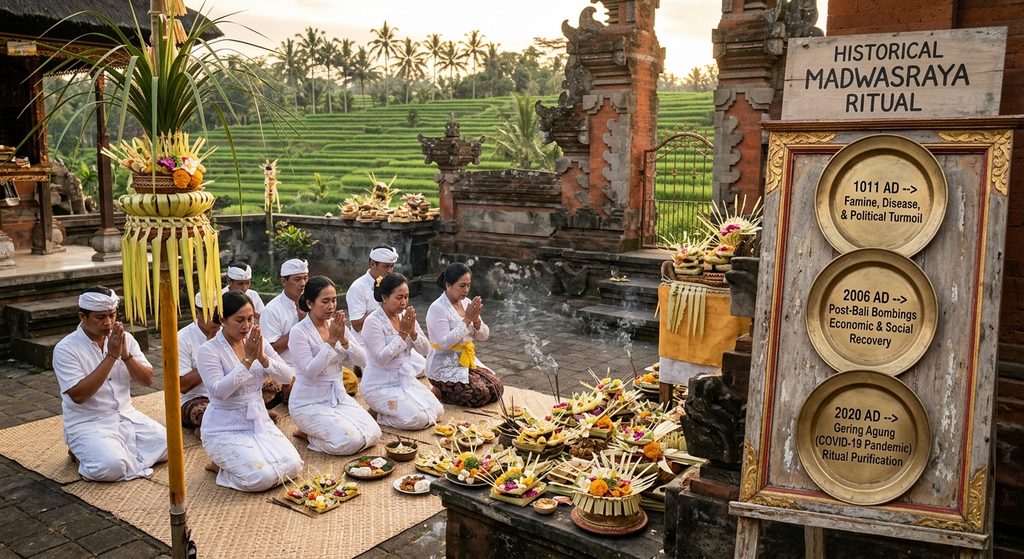
According to the study, the tradition traces Madewasraya back to Saka 933 (around AD 1011) during the reign of Sri Dharmmodayana Warmadewa.
The inscriptional account describes a period of widespread disturbance involving conflict, disease and agricultural failure. These weren’t philosophical riddles for priests to decipher. For people at the time, the problems must have appeared to be very real indeed. People were frightened. Food was threatened. Disease was spreading. And the political world was anything but stable. Something had clearly gone very wrong.
The response? Madewasraya. Knowing this should change our understanding of what the ceremony actually does. It isn’t commemorating something that happened a thousand years ago. It repeats a response to imbalance in a tradition preserved in the historical memory of Bali.
The Ancient Pattern Reappears
Fast-forward to the Bali bombings of 2002 and 2005. Newspaper headlines proclaimed “Paradise Lost,” and in the immediate aftermath, it was. A wave of grief and disbelief swept across the island. Visitor arrivals plummeted, severely impacting a local economy that had become over-reliant on the tourist dollar. The Madewasraya of 2006 was the response.
This was followed by COVID-19. Most of the world was led to believe a virus was spreading through populations around the world, governments imposed lockdowns and restrictions, and scientists told us all about vaccines, masks and social distancing. Bali participated in that modern response, but another response occurred simultaneously. Another Madewasraya.
I Made Sukerta Yasa, Ida Made Windya and I Wayan Titra Gunawijaya from Institut Agama Hindu Negeri Mpu Kuturan Singaraja, explicitly say that the 2020 ceremony was undertaken because of the Gering Agung (AKA The Great Sickness) and was intended to Meruat Jagat, or to ritually purify or restore the world.
This is where viewing Balinese spirituality as primitive science completely misses the point.
The ceremony was never meant to be an alternative to medicine. It was addressing a different question altogether. Whereas Western medicine asks, how do we stop the virus? Madewasraya asked something closer to: How do we restore harmony when our world has become profoundly disordered? And that disorder has manifested itself in sickness.
Those questions are not mutually exclusive and can coexist. And that brings us to the idea beneath almost everything that follows.
Two Worlds That Are Really One
Balinese cosmology frequently distinguishes between Bhuana Agung and Bhuana Alit.
The great world and the small world. The macrocosm and the microcosm.
Bhuana Agung is the larger universe: nature, landscape, cosmic forces, and the world surrounding us. Bhuana Alit is the smaller universe embodied in the human being. The crucial idea in this is correspondence.
The human being is not an isolated creature standing outside the universe looking at it. The small world exists within the great world and reflects it.
Official Balinese descriptions of traditional spatial philosophy still explicitly refer to maintaining harmony between Bhuana Agung and Bhuana Alit. And Madewasraya makes that otherwise abstract concept physical; something mere mortals can see and touch. Because its central substance is water.
The Water on Gunung Abang
This is perhaps the most extraordinary element of the ceremony. The research identifies one of Madewasraya’s central rites as the seeking of sacred water called Tirtha Banyu Geger. This isn’t just water from anywhere. It is found at Gunung Abang.
The Prasasti Pakeling Karya Madewasraya, a ritual inscription cited by the researchers, actually preserves instructions on how the water is collected. The water is taken using the skin of a golden banana and subsequently placed inside yellow bamboo. The inscription associates this sacred substance with removing danger or calamity from the world. Think about that.
We are looking at a ritual instruction from roughly a thousand years ago involving a mountain, water, banana, and bamboo.
Human beings climb into the landscape, collect the water according to prescribed rules and return carrying something understood not simply as water, because now it’s called Tirtha, sacred water, and this Tirtha participates in the restoration of balance.
The cosmology has suddenly become something you can hold in your hands. For a modern Western reader, this inevitably raises another question: what, if anything, has actually changed in the water?
Chemically, perhaps nothing, but within the ritual universe of Madewasraya, its meaning has changed completely. The water has become Tirtha. Whether sacred water can carry something beyond its measurable chemistry is a much larger, and considerably more controversial, question for another day.
Why Water?
Here we again need to distinguish Madewasraya from broader Balinese belief.
Sacred water is fundamental throughout Balinese Hindu practice. But the relationship between water and the Batur region in Kintamani is especially profound.
Historically, Batur has occupied an important position within Bali’s ritual water networks. Research into Pura Ulun Danu Batur describes the temple as standing at the apex of an extensive ritual hierarchy associated with irrigation and agriculture. It’s the Subak system, which is a UNESCO World Heritage Site.
Water descends from Bali’s highlands to sustain communities below. It feeds rivers, enters narrow canals, reaches rice fields, and becomes food. It becomes life.
So, when Balinese philosophy speaks about Tri Hita Kirana and the harmony between humanity, nature and the Divine, this isn’t necessarily an abstract environmental slogan. It’s alive. Like the water.
If you stand above Lake Batur and look down, you can see the living system. Mountain, rain, lake, spring, channel, field, crop, village, human being. One depends upon the other, and if you break the chain, consequences flow downstream.
Madewasraya Goes Further
The Tuluk Biyu research identifies an older theological layer associated specifically with the worship of a Water Deity and subsequently with Vaishnava/Bhujangga traditions and Vishnu.
The researchers argue that the communities around the ancient settlement known as Air Hawang or Air Bang, associated with present-day Abang on the shores of Lake Batur, developed a religious orientation in which the life-giving power of water occupied a central position.
Over time, those traditions interacted with wider Hindu theological traditions. So, what emerges at Tuluk Biyu isn’t simply “Hinduism” imposed upon an earlier Balinese culture.
It’s something characteristically Balinese: layers of belief meeting, adapting and continuing.
It’s an ancient reverence for water, for Vishnu, for Bhujangga traditions, for the mountain, for the temple, for agriculture, and for the community.
All become parts of the same ritual language. And within Madewasraya, that language leads repeatedly back to Tirtha.
The Mountain Isn’t a Backdrop
This also changes how we should look at Gunung Abang. From a modern perspective, we naturally think in terms of venues. The ceremony happens at a temple. Water comes from a mountain. A procession travels through a village.
But sacred geography doesn’t work quite like that, because the landscape actually participates. Gunung Abang isn’t simply the picturesque background against which Madewasraya occurs. It’s the location from which Tirtha Banyu Geger is sought.
Lake Batur isn’t just scenery. Water itself forms part of the theological foundation of the communities surrounding it.
The temple isn’t merely a building in which religious activity happens. It’s part of the relationship connecting people, place and divinity.
This is one reason Bali can be so difficult to understand if we divide everything into the categories familiar to modern Western thought and put religion over here, nature over there, and the community somewhere else. Madewasraya keeps joining them back together.
And Then the Water Returns
What happens to Tirtha Banyu Geger after it is brought down is equally revealing. According to the research, it is distributed to the communities responsible for the temple and can be sprinkled upon agricultural areas or places affected by disaster. Other sacred water associated with the Bhujangga tradition is likewise used within the completion of the Madewasraya rites.
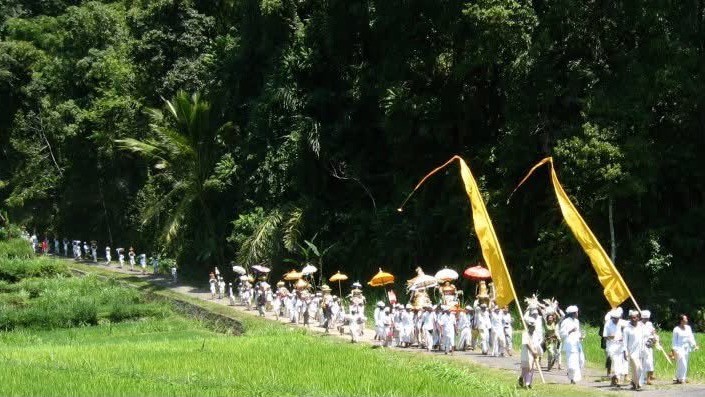
A good way to think about it is this: the community is out of balance, and people turn towards the sacred. They climb the mountain. They find the water, they bring it down to the community, and it reaches the land. This journey itself can be described as an expression of the cosmology, and now we can see Desa, Kala and Patra operating together.
Desa is Gunung Abang, Lake Batur, Pura Tuluk Biyu and the sacred geography surrounding them.
Kala is the appropriate moment, determined within Bali’s sacred conception of time.
Patra is the circumstances, the imbalance requiring a response.
And connecting them is the ritual inherited from those who came before. This isn’t a clock waiting for the planets to line up. It is more a system of relationships.
So, What Is the “Machinery”?
Madewasraya begins with the recognition of imbalance. The macrocosm and microcosm, the Bhuana Agung and Bhuana Alit, are understood as interconnected.
The appropriate ritual response is determined through inherited tradition and the relationship between place, time, and circumstance. At Pura Tuluk Biyu, that tradition reaches back into inscriptions associated with the Warmadewa period.
The community turns towards the sacred landscape. Tirtha Banyu Geger is sought from Gunung Abang according to prescribed ritual forms. Water returns from mountain to community. It is carried outward towards people and land. Prayer, offering, sacred geography and collective participation are woven together to restore harmony.
A Thousand-Year Conversation
Maybe this is why Madewasraya feels so relevant in 2026. We live in an age that likes specialised solutions, with environmental problems belonging to the environmentalists, disease belonging to doctors, infrastructure belonging to engineers and politicians, economic problems belonging to economists, and religion belonging to priests.
Madewasraya comes from a worldview that is much less willing to separate them.
It says that what happens to the land affects the community. What happens within the community affects the individual because human actions have consequences beyond human beings.
Water connects mountain to field. Time has qualities. Place has meaning. And restoring balance requires collective responsibility.
You don’t have to accept the theology literally to recognise the sophistication of the underlying idea.
More than a thousand years after the tradition places the first Madewasraya in the reign of Sri Dharmmodayana Warmadewa, Bali faces pressures its ancestors could never have imagined.
Millions of visitors, water scarcity, waste, traffic, and intensive development. And the increasingly difficult question of how Bali remains Bali while participating in a rapidly changing world.
Madewsraya doesn’t pretend to provide technical answers to any of these issues. That would misunderstand its purpose. Instead, it asks a much older question.
What happens when the relationships holding our world together fall out of balance? And its answer doesn’t begin with a policy document or an engineering plan, but with a journey into the mountains.
To seek water. To bring it home. And to begin restoring the relationship between the small world and the great one.
If you’d like more information or plan to attend the Madewasrya ceremonies at Pura Tuluk Biyu in Kintamani in September and October, get in touch with us at Seven Stones Indonesia, via [email protected]. We’d love to have you on board!
Scan the QR Code below to show your support and help safeguard Bali’s spiritual heritage.