
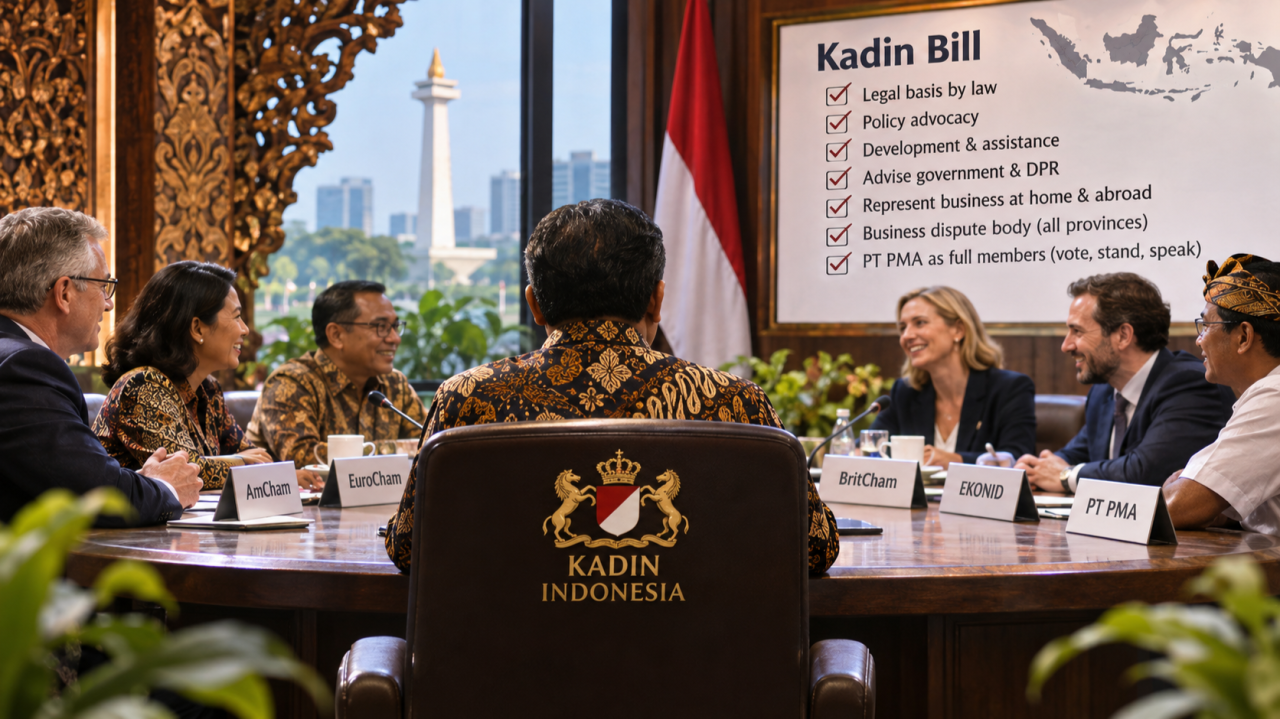
KADIN Bill Indonesia currently being debated in the DPR is not just another piece of bureaucratic housekeeping. It is a fundamental redrawing of the map for how business gets done in this country.
Before diving into the changes, here is the quick context: KADIN (Kamar Dagang dan Industri) is Indonesia’s national chamber of commerce.
Founded in 1968 and legally recognized since 1987, it serves as the single, unified voice of the Indonesian business community. It is the bridge between the private sector and the government—handling everything from policy advocacy to international trade representation.
For decades, foreign businesses have operated on the periphery of this system, relying on their own bilateral chambers (AmCham, EuroCham, etc.) to be heard.
But the new draft law—still in the DIM phase, with plenty of debate left—proposes a massive shift. The most interesting detail for foreign investors? PT PMA companies would officially become ordinary members of KADIN. With the right to vote, stand for election, and speak.
After decades of foreign businesses knocking on doors from the outside, this is a massive change. Here is what is actually happening, and why it matters.
The End of the “Outsider” Era Under the KADIN Bill Indonesia
For years, foreign investors in Indonesia have relied on bilateral chambers—AmCham, EuroCham, BritCham, and others. These organizations do great work. They provide market intelligence, networks, and a seat at the table.
But the new KADIN Bill changes the architecture.
Under the draft, PT PMAs would be named as part of the KADIN family. This isn’t just about paying dues; it is about representation. If a PT PMA can vote inside KADIN, KADIN becomes a direct channel for foreign investors, bypassing the traditional bilateral chambers.
The big question remains: Is membership for a PT PMA a choice or an expectation? The 1987 law left it to the business owner. The new draft, as summarized so far, has not settled this yet. But the direction is clear. The smartest foreign chambers won’t treat KADIN as a rival; they will treat it as the main door. The era of superficial MoUs is ending. The era of real partnership is beginning.
A Double-Edged Sword for Local Associations
While the foreign investor changes get the headlines, the Bill bites hardest for local chambers and associations.
The draft grants KADIN the power to recognize who runs a member association and to accredit company organizations against its own criteria. For anyone who has watched an Indonesian association split into two boards, each claiming to be the legitimate one, this power is massive.
KADIN knows this firsthand. It went through its own contested leadership change in 2024.
However, the Government’s DIM (Daftar Inventarisasi Masalah) is pushing back. The DIM proposes deleting KADIN’s powers, recasting recognition as “development work,” and moving most rules on organization and membership into KADIN’s own articles and bylaws.
This tension says everything: A chamber with teeth? Or a chamber with its own rulebook?
For the regions, there is real promise. Provincial and regency KADIN would sit in one structure with the national body. A provincial dispute body, with mediation and arbitration, could settle quarrels faster than the courts. For anyone building a new business voice in the regions—like the international business community in Bali—the lesson is simple: Don’t build around KADIN. Build alongside it.
KADIN Bill Indonesia: What It Means for the PT PMA on the Ground
The theoretical debates in Jakarta matter, but the practical impact for a PT PMA in Bali is what counts.
If this Bill passes, foreign companies will have a direct line into the national business dialogue. That means no more relying solely on a bilateral chamber to relay concerns about local regulations, zoning, or tax policies.
But with rights come responsibilities. A seat at the KADIN table means showing up. It means understanding the local business landscape beyond just the expat bubble. And it means building relationships with Indonesian business leaders, not just other foreign investors.
The era of treating Indonesia as a place to extract profits and avoid local politics is over. The new KADIN Bill is a formal invitation to join the ecosystem. For those willing to engage, it is a tremendous opportunity. For those who prefer the old way of doing things, it is a warning sign.
One Voice, Many Accents
A single chamber is only as strong as the voices it lets in. The local hotelier in Tabanan. The cooperative in Bangli. The PT PMA in Canggu, with a foreign founder and Balinese staff.
If the final law gives all of them a seat, Indonesia gets something rare. One chamber. One voice. Many accents.
The KADIN Bill Indonesia is still being debated. The Government’s DIM proposes big changes, and everything may shift before a final law is passed. But the direction is clear. The door is opening. The only question is who walks through it.